Transparency first: This guide contains affiliate links. If we’re enrolled in an affiliate program, we may earn a commission at no extra cost to you — it never affects how we research or rank. Read our full affiliate disclosure policy.
Search “left handed chef knife” and you’ll find a lot of ergonomic-handle marketing and very little that actually changes how the blade cuts. Here’s the honest version: most Western double-bevel chef’s knives work fine in either hand — the edge itself isn’t handed, only the handle shape is. Genuine handedness only shows up on single-bevel Japanese-style knives, where a small number of makers grind a true mirror-image blade for left-handed use. Below are the real single-bevel and asymmetric left-handed picks we could verify, plus two ambidextrous Western knives worth buying instead if the true left-handed field doesn’t fit your budget or your kitchen. For the wider field, see our best chef’s knives or our chef’s knife guide.
How we chose
We’re a research-led site, not a testing lab. We checked manufacturer pages and specialist Japanese-knife retailers for products explicitly described as left-handed, and looked for language confirming the bevel or grind is actually reversed — not just a differently shaped handle. We verified current US Amazon availability for every pick directly, one listing at a time, and named the true left-handed knife that isn’t sold on Amazon rather than linking around the gap. Every brand here was screened against the US CPSC recall database, with no active recalls found as of 2026. Prices move constantly, so we use numeric bands and send you to the retailer for today’s number.
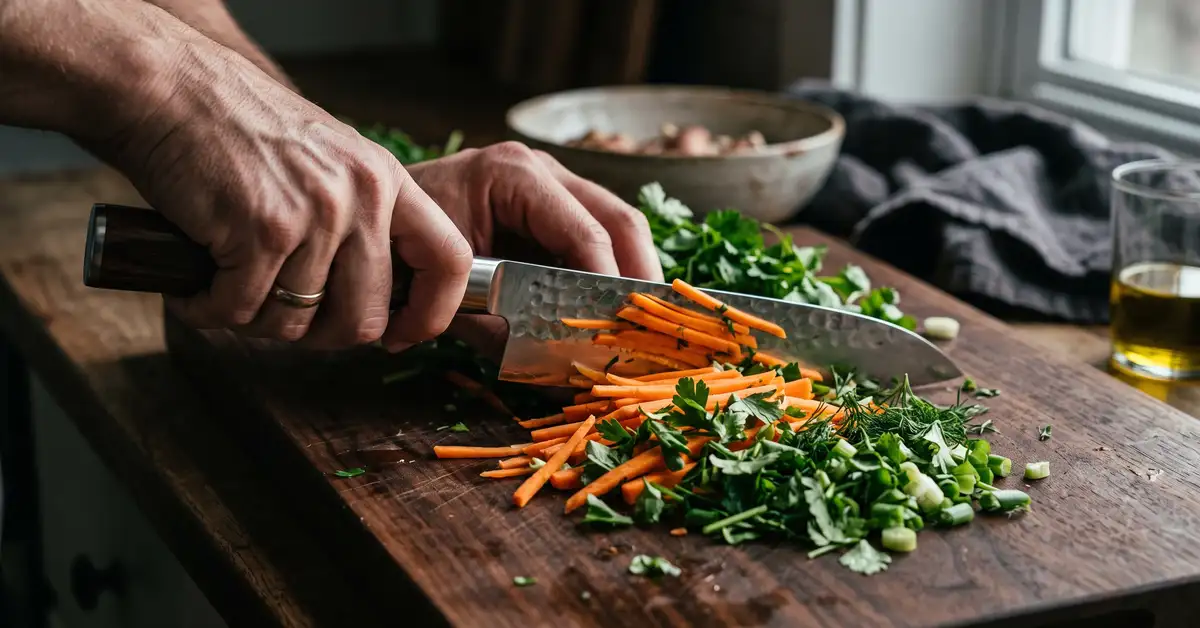
Does a chef’s knife actually need to be “left-handed”?
For most chef’s knives sold in the US, no. A standard Western chef’s knife uses a symmetric double-bevel edge — the same angle ground on both sides of the blade — so the cutting geometry is identical no matter which hand holds it. Left-handed cooks commonly use these knives with no meaningful performance loss; the only real difference is handle comfort, and most modern handles are close enough to neutral that this rarely matters.
Single-bevel Japanese knives are a different story. A single-bevel gyuto, santoku or deba has its bevel ground almost entirely on one face, with the opposite face left flat (or slightly hollowed) to guide food away from the blade as it cuts. That flat face has to be on the correct side of the blade relative to your dominant hand, or the knife steers off-line and the flat side stops doing its job. This is why a small number of Japanese makers grind genuine mirror-image left-handed versions of their single-bevel and strongly asymmetric knives — and why, outside that category, “left-handed chef knife” listings are mostly handle marketing rather than a real edge change.
The picks
1. Masahiro Left-Handed Gyuto, 270mm
What it is: A 270mm (10.6″) gyuto-style chef’s knife from Japanese maker Masahiro, sold as a distinct “Left” model alongside the standard right-handed version — the only left-handed-labeled chef’s knife we could verify as currently listed on Amazon.
Best for: A left-handed cook who wants a maker-designated left-handed chef’s knife without ordering internationally.
Specs: 270mm / 10.6″ blade; alloy steel construction; black-finished handle; sold by the manufacturer as a dedicated “Left” pattern distinct from its standard right-handed twin. Amazon’s own listing data doesn’t consistently specify bevel construction across retailers, so we’re not asserting single-bevel vs. reversed-asymmetric grind here — what’s verifiable is that this is the maker’s dedicated left-handed pattern, not a relabeled standard blade.
- Pros: A genuine maker-designated left-handed model, not just a marketed handle; currently in stock on Amazon with a stable product page.
- Cons: Retailer listings don’t spell out the exact bevel geometry consistently; hand-wash only, like nearly every knife on this page.
2. Misono UX10 Left-Handed Gyuto, 210mm
What it is: A Swedish-stainless gyuto from Misono’s well-regarded UX10 line, sold in an explicit left-handed pattern with a 30/70 asymmetric double-bevel grind biased for left-hand use — the manufacturer’s own retailer describes it as “made for LEFT-handed persons.”
Best for: A left-handed cook who wants a professional-grade Japanese chef’s knife with genuinely reversed edge geometry and doesn’t mind ordering from a specialist importer.
Specs: 210mm / 8.3″ blade; asymmetric double-bevel, 30/70 grind biased for left-hand use; compressed laminated wood handle; hand-wash only.
- Pros: Explicit, retailer-confirmed left-handed grind bias, not a relabeled handle; well-regarded professional Japanese steel and fit.
- Cons: Not listed on Amazon as of 2026-09-12 — buy direct from the retailer, which means international shipping from Japan and no Amazon buyer protections.
3. ZWILLING Gourmet 8″ Chef’s Knife
What it is: A German-forged, symmetric double-bevel Western chef’s knife with no handedness bias built into the edge — a straightforward, widely stocked option for a left-handed cook who doesn’t need single-bevel Japanese geometry.
Best for: A left-handed cook who wants a solid all-purpose chef’s knife at a mainstream price, with zero handedness question to think about.
Specs: 8″ / 20cm blade; forged high-carbon stainless steel; symmetric double-bevel edge; synthetic handle; dishwasher-safe per manufacturer, hand-wash recommended to preserve the edge.
- Pros: Genuinely handedness-neutral edge geometry, not a marketing claim; mainstream price; widely available.
- Cons: Not a substitute if you specifically want single-bevel Japanese cutting performance.
4. WÜSTHOF Classic IKON 8″ Chef’s Knife
What it is: A German forged chef’s knife with a symmetric double-bevel edge and a double-bolster handle, sold as a single standard pattern with no handedness variant — a premium ambidextrous option for a left-handed cook who wants to spend up.
Best for: A left-handed cook who wants a premium all-purpose knife and is comfortable relying on symmetric double-bevel geometry rather than seeking out a true left-handed grind.
Specs: 8″ blade; forged high-carbon stainless steel; symmetric double-bevel edge; double-bolster synthetic handle; hand-wash only.
- Pros: Well-regarded fit and balance; genuinely symmetric edge geometry works equally in either hand.
- Cons: A premium price for a knife with no left-handed-specific grind; some retailer editorial claims a left-handed IKON variant exists, but we could not confirm one on Wüsthof’s own site or on Amazon — see below.
Left-handed chef’s knives compared
| Pick | Type | Blade/format | Where to buy | Price |
|---|---|---|---|---|
| Masahiro Left Gyuto | Maker-designated left-handed | 270mm | Amazon | $150–300 |
| Misono UX10 LH Gyuto | True left-handed, asymmetric grind | 210mm | Direct from Hocho-Knife (import) | $300–700 |
| ZWILLING Gourmet 8″ | Ambidextrous, symmetric double-bevel | 20cm | Amazon | $25–75 |
| WÜSTHOF Classic IKON 8″ | Ambidextrous, symmetric double-bevel | 8″ | Amazon | $150–300 |
What we found but didn’t recommend
A handful of other genuinely left-handed-specific Japanese knives turned up in research, but none fit this page as a straight chef’s-knife recommendation. Sakai Takayuki sells a left-handed single-bevel deba (a fish-butchering knife, not a general chef’s knife) through a US specialist retailer. Gesshin Ittetsu sells a left-handed single-bevel wa-petty (a small trimming knife) through another US importer. Both are real, verifiable left-handed products, but neither is the all-purpose chef’s-knife category this page is about, so we’ve named them rather than built them into the list above.
We also saw editorial claims (not manufacturer or Amazon listings) that Wüsthof sells a left-handed variant of its Classic IKON chef’s knife. We could not find that specific left-handed variant on Wüsthof’s own site or on Amazon, so we’re not recommending it as a verified product — the standard IKON above is a genuinely ambidextrous knife on its own merits, not a stand-in for an unconfirmed left-handed version.
How to tell if a “left-handed” chef’s knife listing is the real thing
- Look for a stated bevel side or grind ratio (e.g., “30/70 left-handed grind” or “bevel on the left face”). If a listing says this explicitly, treat it as genuine.
- A matched right-handed twin at the same price and size is a good sign. A maker selling both versions (like Misono’s UX10 line) is telling you the geometry genuinely differs between them.
- “Ergonomic handle” alone is not enough. If a listing only describes handle shape with no mention of bevel or grind orientation, it’s most likely a standard double-bevel blade in different packaging — which, to be fair, is not a problem for most Western-style chef’s knives anyway.
- If you don’t need single-bevel Japanese geometry, a symmetric double-bevel Western knife sidesteps the question entirely. Both alternatives above use genuinely handedness-neutral edges.
Frequently asked questions
Do left-handed cooks need a special chef’s knife?
Usually not. Most Western chef’s knives use a symmetric double-bevel edge that performs the same in either hand — only handle comfort differs, and modern handles are generally close enough to neutral that this rarely matters. True handedness mainly applies to single-bevel Japanese knives like a single-bevel gyuto, santoku, or deba.
Is there a genuinely left-handed chef’s knife sold on Amazon?
Yes: the Masahiro Left-Handed Gyuto, 270mm, is sold by the manufacturer as a distinct left-handed pattern and is currently listed on Amazon. Other true left-handed chef’s knives we verified, like the Misono UX10 LH Gyuto, are sold only through specialist importers, not Amazon.
What actually makes a knife “left-handed” rather than just marketed that way?
A stated reversal of the bevel side or grind ratio — for example, a single-bevel edge ground on the left face instead of the right, or an asymmetric double-bevel grind biased for left-hand use. A listing that only describes an ergonomic handle, with no mention of the edge itself, is most likely a standard blade in different packaging.
Can I just use a standard chef’s knife left-handed?
For the vast majority of Western double-bevel chef’s knives, yes, with no meaningful performance loss. The exception is single-bevel Japanese knives, where using a right-handed blade left-handed causes the flat guiding face to sit on the wrong side and the blade to steer off-line.
How do I sharpen a left-handed single-bevel knife?
Carefully, and respecting the original bevel side. A single-bevel or strongly asymmetric edge needs a sharpening approach that preserves which face carries the primary bevel; treating it like a standard symmetric double-bevel edge on a whetstone can grind away the very geometry that makes it left-handed.
The verdict
If you specifically want a maker-designated left-handed chef’s knife without ordering internationally, the Masahiro Left-Handed Gyuto is the verified pick on Amazon today. Want genuinely reversed single-bevel-style geometry from a top-tier Japanese maker and don’t mind importing, the Misono UX10 LH Gyuto. If you don’t need single-bevel Japanese performance and would rather sidestep the handedness question entirely, the ZWILLING Gourmet or WÜSTHOF Classic IKON are both genuinely ambidextrous options at two different price points. For the wider field, see our best chef’s knives.
Sources & method: Specifications and left-handed geometry claims verified against manufacturer and specialist-retailer documentation (Masahiro, Misono/Hocho-Knife, Sakai Takayuki/Chubo Knives, Gesshin Ittetsu/Japanese Knife Imports, Seisuke Knife, ZWILLING, Wüsthof) and current Amazon US listings, checked live 2026-09-12. Screened against the US Consumer Product Safety Commission (CPSC) recall database and Recalls.gov; no active recalls found for the brands above as of 2026. We don’t physically test knives ourselves — here’s how we choose.