Transparency first: This guide contains affiliate links. If we’re enrolled in an affiliate program, we may earn a commission at no extra cost to you — it never affects how we research or rank. Read our full affiliate disclosure policy.
You do not need a fifteen-piece block to cook well. You need one good knife, then a couple of friends for it, and — only if you’d genuinely rather buy once — a small set. That’s the honest, no-overspend path to your first kitchen knives, and it’s the one nearly every professional would point a beginner toward. This guide walks that path in order: the single knife to buy first, the three-knife core that handles almost everything, and when a set actually makes sense. If you want the full shortlist of specific models, jump to our best chef’s knives; if you’d like to understand the parts and steel first, start with the complete chef’s knife guide. (Updated for 2026.)
Start with one knife: a chef’s knife
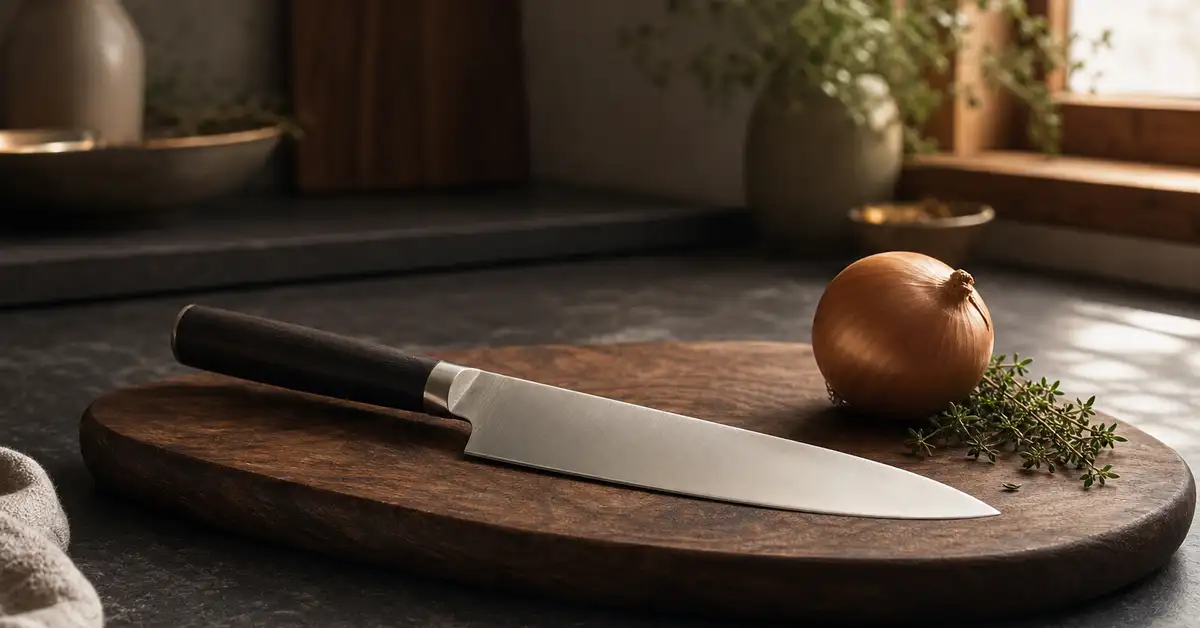
If you buy a single kitchen knife, make it an 8-inch chef’s knife. It’s the one tool that does roughly eighty percent of everyday prep — chopping onions, mincing garlic, slicing meat, breaking down vegetables — and learning to use one well is the biggest jump in ability a home cook can make. A dedicated paring or bread knife is useful, but neither is the workhorse. Buy the chef’s knife first, cook with it for a few weeks, and you’ll understand your own preferences far better before you spend another cent.
You don’t need to spend much, either. The single best piece of beginner advice in cutlery is that a great chef’s knife sits in the budget-to-mid range, not the top of the market. Two honest starting points cover almost everyone:
The two first knives we’d hand almost anyone
The Victorinox Fibrox Pro 8-inch is the best value in cutlery — light, grippy, genuinely sharp, and used in professional kitchens the world over (price band $). If you’d rather have a forged, keep-for-decades blade, the Wüsthof Classic 8-inch is the do-everything upgrade (price band $$$). Either is a knife you won’t outgrow.
The three-knife core kit
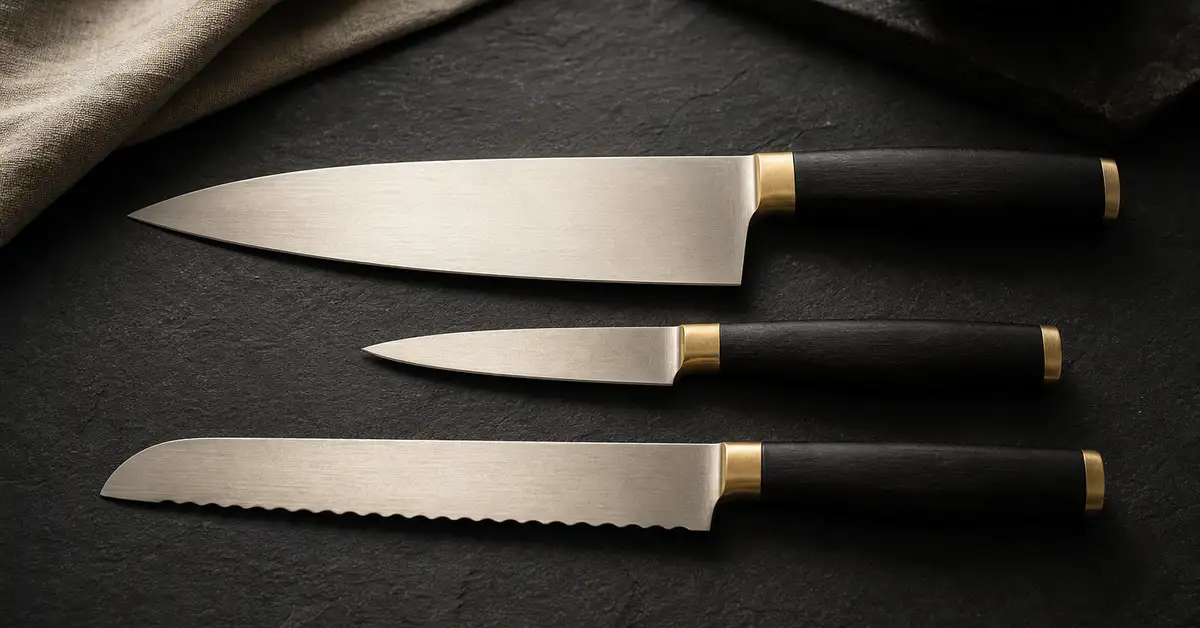
Once you have the chef’s knife, two more blades round out a kit that will handle almost everything a home kitchen throws at you. Experts and testers converge on the same trio, and it’s worth understanding why each earns its place.
- The chef’s knife (8-inch): your primary tool for chopping, slicing, dicing and mincing. If you only ever sharpen one knife, sharpen this one.
- A paring knife (3–4 inch): for the small, in-hand jobs a big blade makes awkward or unsafe — peeling, hulling strawberries, deveining, trimming and precise little cuts.
- A serrated knife (bread/utility): the one that slips cleanly through crusty bread, tomatoes and citrus without crushing them. A serrated edge tears rather than slices, so it stays useful even as it dulls — which is why you rarely need to sharpen it.
That’s the whole kit for most people. Add a utility or slicing knife later if you carve a lot of roasts, and steak knives if you entertain — but those are add-ons, not starting points. Buying these three well beats buying fifteen mediocre blades every single time.
Then — if you’d rather buy once — a small set
Some people would simply prefer to buy everything at once, and that’s fine — as long as you buy a small, well-chosen set rather than a towering block. The same rule applies: a compact set built around good versions of the core knives will out-cook a big bargain block padded with steak knives and near-duplicate utility blades. A three-knife set on a magnetic stand or a forged six-piece block from a reputable maker is a far better first purchase than a fifteen-piece special.
We break down the specific options — from compact trios to forged blocks — in our full guide.
Prefer to buy a set?
A compact, quality set is the sensible “buy once” route for a new kitchen. Our roundup covers the best from starter blocks to pro-grade.
What you don’t need yet
Part of buying well is knowing what to skip. A brand-new kitchen almost never needs a big knife block, a santoku and a chef’s knife (they overlap heavily), a cleaver, a boning knife, a full set of steak knives, or any of the single-task gadget blades that fill discount sets. These aren’t bad tools — they’re just not where a beginner’s money should go first. Buy the core three, cook for a while, and add a specialty knife only when you notice yourself actually wanting it. You’ll spend less and end up with a kit that fits how you cook.
Keep them sharp from day one
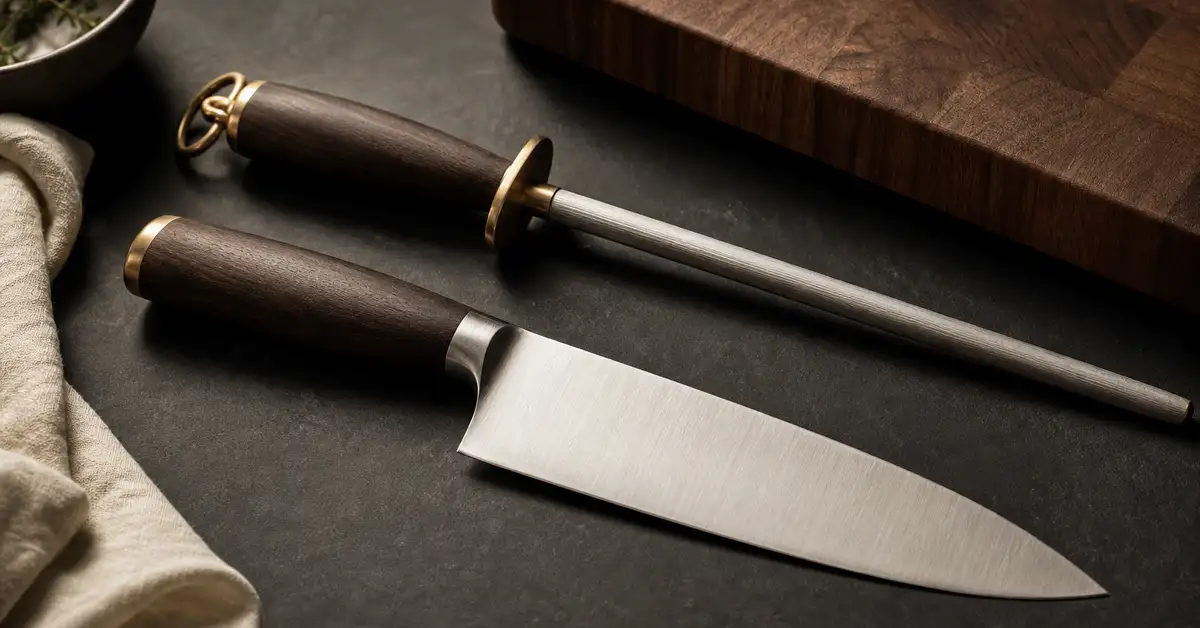
A good first knife stays good only if you look after it, and the habits are simple. Hone the edge every few uses with a honing steel to keep it aligned; actually sharpen it (on a whetstone, a quality pull-through, or via a professional service) every 6–12 months. Hand-wash and dry your knives rather than putting them in the dishwasher, and always cut on wood or soft plastic — never glass, stone or the countertop, which wreck an edge fast. Store them in a block, on a magnetic strip or in blade guards, not loose in a drawer. And remember the counterintuitive rule: a sharp knife is the safe one, because a dull blade needs more force and is more likely to slip. For the full walk-through of parts, steel and care, see the complete chef’s knife guide.
Frequently asked questions
What is the best first kitchen knife?
An 8-inch chef’s knife. It handles the large majority of everyday prep, so it’s the one knife worth buying and learning first. For a budget-friendly, professional-grade option the Victorinox Fibrox Pro is the standard pick; for a forged knife you’ll keep for decades, the Wüsthof Classic. See our full shortlist for more.
What three knives do I actually need?
A chef’s knife, a paring knife and a serrated (bread) knife. The chef’s knife does the bulk of the work, the paring knife handles small in-hand jobs, and the serrated knife slices bread and tomatoes cleanly. That trio covers almost everything a home cook does.
Should I buy single knives or a set?
Either works — it’s about how you like to shop. Buying single knives lets you get the best chef’s knife for your money and add pieces as you go. If you’d rather buy once, choose a small, quality set over a big block; see our best knife sets guide. Avoid giant blocks padded with pieces you won’t use.
How much should a beginner spend on a knife?
Less than you might think. A genuinely excellent chef’s knife sits in the budget-to-mid band — the jump from a cheap knife to a good one is huge, while the jump from a good one to a luxury one is subtle. Start modestly, learn what you like, and upgrade later if you want to.
Do I need an expensive or Japanese knife to start?
No. A forgiving, easy-to-sharpen Western knife is the better first buy for most beginners. Harder Japanese steel is wonderful but less forgiving of the board-scraping and twisting that new cooks tend to do. You can always add a Japanese knife once your technique and confidence grow.
The bottom line
The best first knife isn’t expensive or exotic — it’s one good 8-inch chef’s knife you’ll actually learn to use, backed by a paring knife and a serrated knife when you’re ready. Skip the big block, keep your edges sharp, cut on wood, and add specialty knives only as real needs appear. Do that and you’ll spend less, cook better, and end up with a kit that genuinely fits your kitchen. When you’re ready to choose a specific model, start with our best chef’s knives or, if you’d rather buy a set, our best knife sets.
Sources & method: Beginner knife guidance synthesized from our own research-led guides and the consensus of reputable editorial testers (America’s Test Kitchen, Serious Eats, NYT Wirecutter, Good Housekeeping, The Kitchn) and knife specialists (KitchenKnifeGuru, Nothing But Knives); model specifications from manufacturer documentation (Victorinox, Wüsthof). We don’t physically test knives — here’s how we choose.