Transparency first: This guide contains affiliate links. If we’re enrolled in an affiliate program, we may earn a commission at no extra cost to you — it never affects how we research or rank. Read our full affiliate disclosure policy.
A knife is only as good as its edge, and every edge needs a plan. Whether that plan is a plug-in machine, a rolling gadget, or a stone and some patience, the goal is the same: raise a clean new edge without wrecking the steel that took real craftsmanship to forge. Below are the twelve sharpeners and honing tools that earn their keep in 2026 — electric, manual, guided and stone — plus the honest trade-offs of each, so you can match a tool to your knives and your patience for technique. New to sharpening altogether? Start with our chef’s knife guide for the steel and edge basics first.
How we chose
We’re a research-led site, not a testing lab, and we won’t pretend otherwise — we don’t run our own edge-retention rigs or claim to have personally sharpened and rated every tool below. We start from each maker’s own specs — abrasive type, stage count, the angles a system actually cuts — then weigh those against outlets that do put sharpeners through repeatable trials: America’s Test Kitchen, Good Housekeeping, YourBestDigs’ multi-thousand-stroke comparisons, Food & Wine, Outdoor Life and MeatEater, alongside sharpening-specific technical writing from Serious Eats, EdgePro and the specialist site KitchenKnifeGuru. We favor tools with real independent backing over marketing claims, we flag where credible reviewers disagree (aggressive electric grinding is the big one), and we screened every pick against the US CPSC recall database. Prices move, so we use price bands rather than list a number for each pick — our ladder runs under $25 · $25–75 · $75–150 · $150–300 · $300–700 · $700+ — and we send you to the retailer for today’s figure. Here’s our full method.
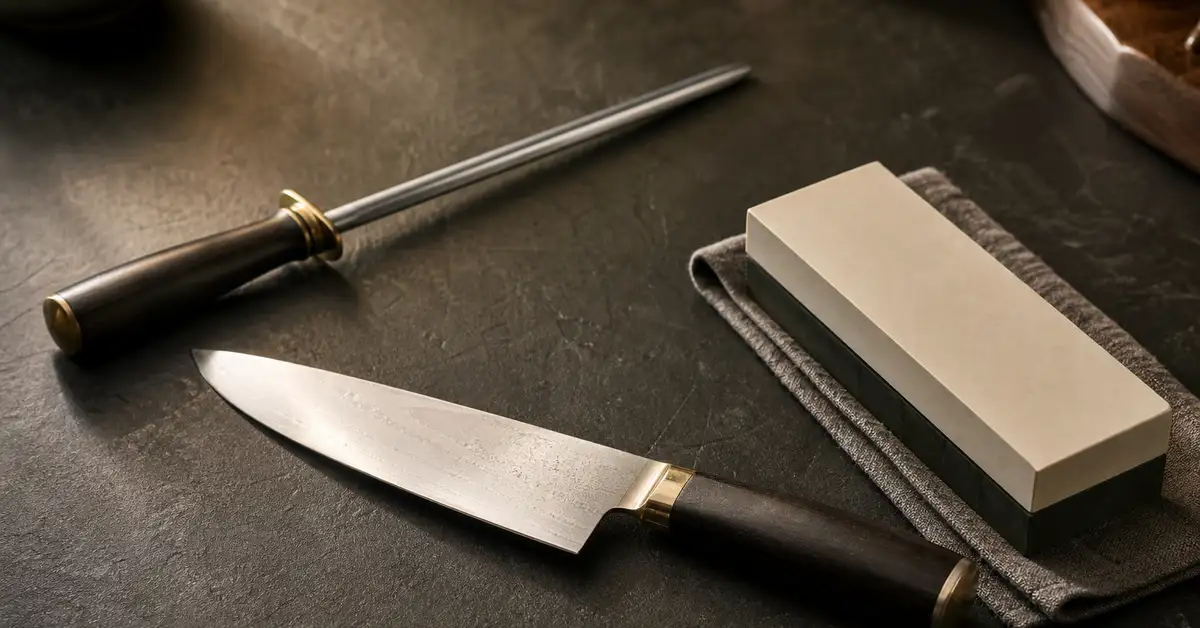
The best knife sharpeners of 2026
1. Chef’sChoice Trizor XV EdgeSelect (Model 15)
What it is: The three-stage electric sharpener that’s become the default “buy this and stop worrying” pick for home cooks who want machine-consistent sharp knives.
Best for: Households that sharpen often, own mostly Western-style knives, and want speed over stone technique.
Specs: Three-stage electric sharpener; 100% diamond abrasives in stages one and two, a flexible stropping/polishing stage three; converts a factory Western edge to a 15-degree-per-side “Trizor” edge; handles straight and serrated knives; a full sharpening cycle takes about a minute once you know the drill.
- Pros: Extremely consistent results, genuinely fast, minimal skill required, widely endorsed by test kitchens.
- Cons: Removes more metal per session than stones or gentler systems; some knife specialists caution against frequent use on delicate or high-end blades.
Why we trust it: Good Housekeeping’s and Business Insider’s top overall pick in independent 2024–2025 sharpener round-ups, with the manufacturer citing further endorsements from major test kitchens and food publications.
2. Chef’sChoice AngleSelect 1520
What it is: The Trizor’s sibling machine, built to handle both Japanese-style and Western-style edges in one device instead of forcing a single geometry.
Best for: Mixed-knife households — a Japanese gyuto next to a Western chef’s knife — who want one machine to cover both.
Specs: Three-stage electric sharpener; diamond abrasives in stages one and two plus a polishing stage three; selectable 15-degree and 20-degree per-side slots; scored top of the field in an independent nine-sharpener, multi-thousand-stroke comparison.
- Pros: Dual-angle flexibility most electrics don’t offer, top independent test result, easy to use straight out of the box.
- Cons: Same metal-removal trade-off as any diamond-wheel electric; sits at a premium price alongside the Trizor.
Why we trust it: YourBestDigs’ 2026 comparison — over 5,000 sharpening strokes across nine competing sharpeners — ranked the AngleSelect 1520 its top performer.
3. Work Sharp Culinary E5
What it is: A gentler electric sharpener that draws the blade across flexible abrasive belts instead of rigid diamond wheels, with a bonus honing rod in the box.
Best for: Cooks who want electric convenience with a lighter touch on their steel, plus a machine that also handles shears and serrated edges.
Specs: Electric belt sharpener; guides set at a 17-degree angle, with optional steeper and shallower guides sold separately; auto-timed shape, sharpen and hone cycles finish in under 90 seconds; also sharpens serrated knives, kitchen shears and poultry shears; includes a ceramic honing rod.
- Pros: Flexible belts are gentler than fixed diamond wheels; handles shears and serrations most electrics can’t; auto-timed cycles reduce the risk of over-sharpening.
- Cons: Less widely covered by mainstream test kitchens than Chef’sChoice; still an electric, so it removes more metal than any stone.
Why we trust it: Work Sharp’s culinary line is developed in partnership with Serious Eats’ knife-care editorial team, and it’s a recurring pick in Food & Wine’s electric-sharpener testing.
4. AccuSharp Knife & Tool Sharpener
What it is: A simple, inexpensive carbide pull-through that restores a working edge in seconds flat — no plug, no stones, no angle guesswork.
Best for: A fast, cheap backup sharpener for everyday knives, or a first sharpener before you invest in anything more involved.
Specs: Manual pull-through sharpener; diamond-honed tungsten carbide blades preset around a Western angle; reversible carbide inserts extend the tool’s working life; compact and dishwasher-safe.
- Pros: Genuinely cheap, fast, and endorsed by a major test kitchen; carbide inserts flip over for a second life.
- Cons: Coarse, fixed-angle action removes more metal than a refined system; not gentle enough for delicate Japanese steel.
Why we trust it: America’s Test Kitchen’s longtime equipment editor has named AccuSharp among the best manual sharpeners in the outlet’s own published testing.
5. Work Sharp Precision Adjust
What it is: An affordable clamp-and-guide system that removes the guesswork of freehand stone sharpening without the cost of a premium jig.
Best for: Cooks ready to learn real sharpening technique on a budget, who want angle control without freehanding a stone.
Specs: Guided-angle manual system; V-block knife clamp; angle tower adjustable across a wide per-side range covering both Japanese and Western geometries; a tri-abrasive plate (coarse, medium, fine) mounted on a pivoting arm.
- Pros: Real angle control at an accessible price; built-in grit progression in one tool; works on kitchen and outdoor knives alike.
- Cons: Slower than any electric machine; still requires clamping the knife and working the arm by hand.
Why we trust it: Specialist sharpening retailers call it one of the easiest ways they’ve found to learn guided sharpening at its price point, and knife-focused outlets consistently flag it as an affordable, effective jig.
6. Work Sharp Professional Precision Adjust (and Elite)
What it is: The upgraded Precision Adjust — more abrasive options and a sturdier build for cooks who want the best possible edge from a guided jig rather than a full custom rig.
Best for: Enthusiasts sharpening a mixed collection — Japanese and Western knives, plus the odd outdoor blade — who want a system that scales with them.
Specs: Enhanced guided-angle system building on the base Precision Adjust architecture; wide adjustable angle range per side; an expanded abrasive plate versus the entry model; offered in a step-up “Elite” configuration with further refinements.
- Pros: Versatile across knife types, finer finishes available than the base model, still far cheaper than a fully custom sharpening jig.
- Cons: Costs meaningfully more than the base Precision Adjust; more grit stages to learn to use well.
Why we trust it: Outdoor Life’s 2026 knife-sharpener guide names the Professional Precision Adjust its overall best pick, with the Elite variant singled out as a standout mid-price option.
7. Spyderco Tri-Angle Sharpmaker
What it is: A compact ceramic-rod system that’s stayed a favorite for decades — famous for turning sharpening novices into confident users in a single sitting.
Best for: Cooks who want a fast-to-learn manual system that also handles serrated bread knives well, not just straight edges.
Specs: Triangular medium and fine ceramic rods set into a base at two fixed inclusive angles, covering both acute Japanese-style and more robust Western-style edges; the rods’ corners sharpen serrations while the flats hone and refine; includes safety guard rods.
- Pros: Genuinely easy to pick up; unusually versatile (straight and serrated edges, even small pointed tools); compact and portable.
- Cons: Better at maintaining an edge than rescuing a badly damaged one; ceramic-only, with no coarse stage for major repairs.
Why we trust it: A long-running favorite in specialist knife-review outlets, and named a top pick for kitchen sharpening by independent gear guides.
8. Lansky Deluxe 5-Stone Sharpening System
What it is: A classic clamp-and-rod system bundling five stones of different coarseness, for cooks who want true multi-grit progression without freehanding.
Best for: Reviving very dull or chipped knives, and enthusiasts who enjoy traditional oil-stone technique over a modern dial-based jig.
Specs: Clamp-based guided system; five stones from extra-coarse to extra-fine; guide rods that set several angle options per side to suit different knife styles; includes honing oil and a molded carry case.
- Pros: Genuine multi-stage grit progression, strong for repairing damaged edges, reliable angle control once the clamp is set up correctly.
- Cons: Fiddlier setup than a dial-based system — rod alignment, clamp position, oil management; a steeper learning curve overall.
Why we trust it: Outdoor Life’s 2026 guide names it a standout budget fixed-angle sharpener, and specialist knife reviewers credit it with genuinely sharp results once the technique is understood.
9. Horl 2 Rolling Knife Sharpener
What it is: A striking rolling sharpener — the knife sits still in a magnetic wood cradle while a diamond-and-ceramic roller does the work of shaping and refining the edge.
Best for: Cooks who want a countertop-worthy tool and close-to-foolproof angle control on straight-edged Western and everyday knives.
Specs: Magnetic angle support offering two angle settings to suit Japanese-style or Western-style edges; a rolling cylinder carries a diamond disc for shaping and a ceramic disc for refining; solid-wood body; finer discs available separately for enthusiasts.
- Pros: Angle control is essentially guaranteed since the knife itself never moves; handsome enough to leave on the counter; fast for routine touch-ups.
- Cons: A genuine splurge for what it does; less suited to very thin Japanese profiles or heavily curved blades; go easy with the diamond disc on harder steel.
Why we trust it: Outdoor Life names the Horl 2 Pro its pick for kitchen knives specifically, and independent reviewers consistently praise its simplicity on mainstream Western steels.
10. Sharpal 162N Dual-Grit Diamond Whetstone
What it is: A dual-grit diamond plate that skips the soaking and flattening rituals that put many beginners off traditional stones entirely.
Best for: A first stone for cooks ready to learn freehand sharpening on ordinary Western stainless knives.
Specs: Dual-grit diamond plate with a coarse side for resetting a dull edge and an extra-fine side for refining; steel-backed for long-term flatness; a built-in angle guide covering several common angles; usable with a splash of water, no soaking required.
- Pros: No soaking or flattening upkeep, a genuinely durable diamond surface, and a built-in angle guide that helps beginners find their footing.
- Cons: Diamond abrasive is more aggressive than ceramic, so go gently on harder, lower-hardness Japanese steel; still requires practicing freehand technique.
Why we trust it: Outdoor Life’s 2026 guide names it the top sharpening stone in its round-up.
11. Shapton Pro 1000 Kuromaku Ceramic Whetstone
What it is: A globally respected ceramic waterstone that specialist retailers say anchors more sharpening kits than any other — the medium stone most enthusiasts reach for first.
Best for: Owners of harder Japanese steel — santoku, gyuto, nakiri — and enthusiasts ready to commit to freehand stone technique.
Specs: Medium-grit ceramic waterstone designed to be splash-and-go rather than long-soaked; fast-cutting yet controlled abrasion suited to harder steels; compact enough to store in a drawer, with a storage case that doubles as a holder.
- Pros: An excellent balance of speed and refinement; gentler on hard steel than a diamond plate; holds its geometry well between flattenings.
- Cons: Needs periodic flattening like any waterstone; freehand angle control takes real practice; one stone alone won’t chase a mirror polish.
Why we trust it: Widely cited by specialist sharpening retailers and sharpening educators as a default medium stone, and it fits expert guidance to favor ceramic over diamond on harder Japanese steel.
12. Ceramic Honing Rod (Noble Home & Chef or equivalent)
What it is: Not a sharpener at all, but the tool that makes every sharpener above last longer between visits — a ceramic or smooth-steel rod that realigns a bent edge in seconds.
Best for: Every kitchen, regardless of which sharpener you own — honing is the maintenance step sharpening can’t replace.
Specs: Ceramic honing rods often offer two grit levels in one tool; used at the knife’s factory angle — shallower for Japanese knives, wider for Western ones; realigns the edge rather than grinding it, so it does not meaningfully remove metal.
- Pros: Inexpensive, safe to use often, and genuinely extends the time between real sharpenings.
- Cons: Cannot restore a truly dull edge on its own — that still needs a sharpener; even a ceramic rod is mildly abrasive, so use a light touch.
Why we trust it: Recommended alongside other specialist picks by The Kitchn’s expert round-up, and Outdoor Life names a Noble Home & Chef rod its top honing rod for 2026.
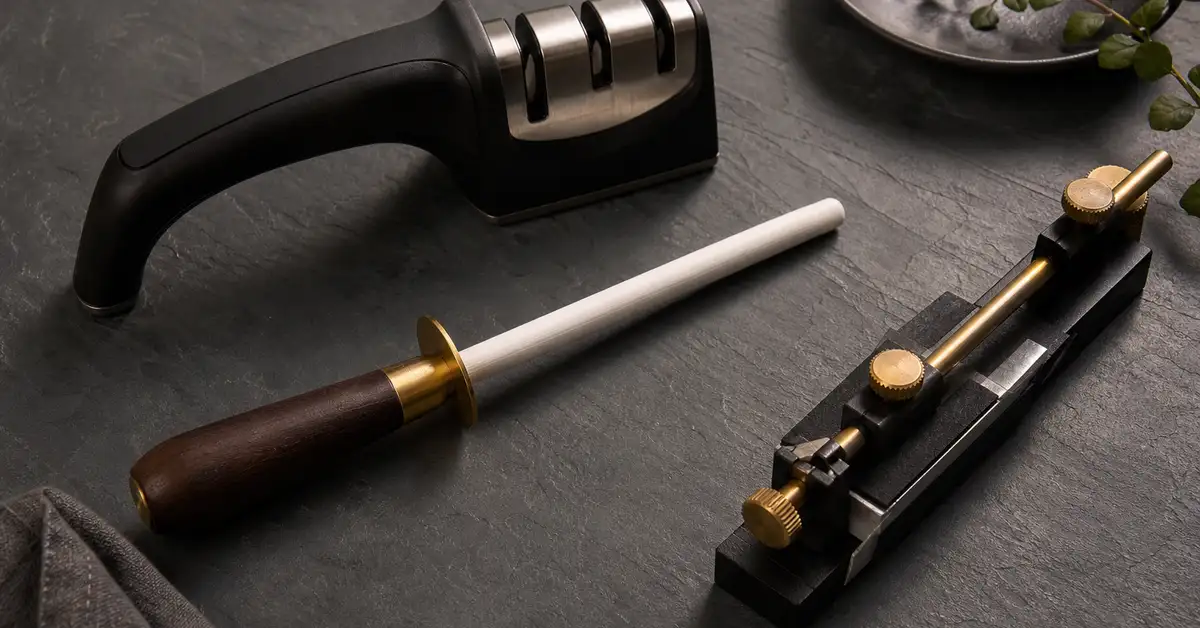
Knife sharpeners compared
| Sharpener | Best for | Type / angle control | Metal removal | Price |
|---|---|---|---|---|
| Chef’sChoice Trizor XV | Best overall electric | Electric, fixed 15° guides | Higher | $75–150 |
| Chef’sChoice AngleSelect 1520 | Best all-in-one electric | Electric, selectable 15°/20° | Higher | $75–150 |
| Work Sharp Culinary E5 | Best belt-driven electric | Electric belt, guided angle | Moderate | $75–150 |
| AccuSharp Knife & Tool | Best manual pull-through | Manual, fixed angle | Higher | under $25 |
| Work Sharp Precision Adjust | Best budget guided system | Manual, dial-adjustable | Moderate | $25–75 |
| WS Professional Precision Adjust | Best guided system overall | Manual, dial-adjustable | Moderate | $150–300 |
| Spyderco Sharpmaker | Best for serrated knives | Manual, fixed inclusive angles | Low–moderate | $75–150 |
| Lansky Deluxe 5-Stone | Best traditional multi-stone kit | Manual, clamp + guide rods | Moderate–higher | $25–75 |
| Horl 2 | Best splurge | Rolling, fixed magnetic angles | Moderate | $150–300 |
| Sharpal 162N | Best beginner whetstone | Freehand stone, guide included | Moderate | $25–75 |
| Shapton Pro 1000 | Best for Japanese steel | Freehand stone | Low–moderate | $25–75 |
| Ceramic honing rod | Best daily maintenance | Honing only, matches factory angle | Minimal | under $25 |
How to choose a knife sharpener
Before you pick a product, it’s worth settling a few questions that matter more than any single brand name:
- Match the angle to your knives. Western chef’s knives are typically ground wider per side than Japanese-style knives, which run more acute for finer slicing. A sharpener that grinds at the wrong angle either weakens a delicate edge or leaves a Western knife feeling under-sharpened — several picks above offer selectable angles for exactly this reason.
- Understand grit progression. Real sharpening moves coarse to fine: a coarser abrasive raises a burr along the whole edge, a medium grit refines the bevel, and a fine grit or strop cleans up the apex. Skipping straight to a fine stage without first raising a burr is the most common beginner mistake. See our step-by-step how-to for the full walkthrough.
- Know that honing and sharpening are different jobs. Honing realigns a rolled edge with a rod and barely removes metal; sharpening grinds a new edge with an abrasive. Hone often, sharpen only when honing stops helping — see honing vs sharpening for the full picture.
- Weigh convenience against metal removal. Electric machines are the fastest route to consistently sharp knives, but every credible source agrees they remove more steel per session than a guided system or stone. If you own knives you want to keep for decades, that trade-off is worth thinking about up front.
Frequently asked questions
What is the best knife sharpener overall in 2026?
For most home cooks who want fast, consistent results, the Chef’sChoice Trizor XV is the safest overall pick. If you own a mix of Japanese and Western knives, the AngleSelect 1520’s dual-angle guides make it more versatile. If you’d rather learn real technique, the Work Sharp Precision Adjust family is our top guided-system recommendation.
Is an electric knife sharpener bad for your knives?
Used as directed, no — but electric machines do remove more metal per session than a stone or guided system, since their diamond wheels grind quickly by design. That’s a fine trade for everyday knives you’ll replace eventually, and worth thinking about more carefully for an expensive or heirloom blade.
How often should I sharpen versus hone my knife?
Hone before most uses, or at least every few sessions — it takes seconds and barely touches the steel. Sharpen only a couple of times a year for typical home use, more often if you cook daily or cut through tougher ingredients. If honing stops restoring a crisp edge, it’s time to sharpen.
What’s the right sharpening angle for my knives?
Western chef’s knives are typically sharpened wider per side than Japanese-style knives, which run more acute. Check your knife’s factory spec if you can, and choose a sharpener with guides or settings that match it — several picks above cover both ranges in one tool.
Do I need a whetstone, or is a pull-through sharpener enough?
A quality pull-through or electric sharpener is genuinely enough for most everyday kitchens. A whetstone earns its place once you own knives worth babying — especially harder Japanese steel — or you enjoy the process itself. Many cooks end up with both: a quick electric or guided tool plus a stone for the knives they care about most.
Are cheap knife sharpeners worth buying?
The best budget picks above are worth buying — they’re backed by real independent testing. The cheapest, unbranded gimmick sharpeners generally aren’t; several have been shown in independent reviews to under-deliver on sharpness despite being easy to use. Buy at the value floor we recommend, not below it.
The verdict
If you want the least effort for a consistently sharp kitchen, the Chef’sChoice Trizor XV or the dual-angle AngleSelect 1520 are the safe electric picks. On a tighter budget, AccuSharp is the honest, well-reviewed manual option. If you’re ready to learn real technique, start with the Work Sharp Precision Adjust family or the classic Spyderco Sharpmaker, and step up to a Shapton or Sharpal whetstone once you own knives worth the extra care. Whatever you choose, pair it with a good honing rod — it’s the cheapest habit that keeps any edge working longer. For the full picture of what these tools actually do to an edge, see our chef’s knife guide.
Sources & method: Specifications drawn from manufacturer documentation (Chef’sChoice/EdgeCraft, Work Sharp/Darex, AccuSharp, Spyderco, Lansky, Horl, Sharpal, Shapton, Noble Home & Chef and equivalents); performance and ranking claims drawn from America’s Test Kitchen, Good Housekeeping, YourBestDigs, Food & Wine, Outdoor Life, MeatEater, Business Insider, The Kitchn, Serious Eats, EdgePro and KitchenKnifeGuru. Screened against the US Consumer Product Safety Commission (CPSC) recall database; no active recalls found for the recommended sharpeners or whetstones as of 2026. We don’t physically test sharpeners ourselves — here’s how we choose.