Transparency first: This guide contains affiliate links. If we’re enrolled in an affiliate program, we may earn a commission at no extra cost to you — it never affects how we research or rank. Read our full affiliate disclosure policy.
If you’ve already decided on 8 inches — the standard length for a home chef’s knife — the next question is which specific 8-inch blade actually suits how you cook. This list is narrower than a general “best chef’s knife” roundup: every pick here is evaluated specifically at the 8-inch length, looking at how blade height, weight and balance play out at this exact size, since a knife that feels great at 6 or 10 inches doesn’t always translate cleanly to 8. Below are 8 genuinely distinct 8-inch chef’s knives worth buying in 2026, from a budget forged workhorse to a Japanese Damascus splurge. Not sure 8 inches is even the right call for you? See our chef’s knife guide for sizing first, or our best chef’s knives for the broader field. (Updated for 2026.)
How we chose
We’re a research-led site, not a testing lab — we don’t run our own edge-retention rigs. We built this list from current manufacturer specifications (blade steel, hardness in HRC, edge angle, weight and blade height) and cross-checked performance claims against specialist knife reviewers and editorial coverage. Every pick is independently confirmed as currently sold through the manufacturer or a major US retailer, and screened against the US CPSC recall database — no active recalls found for any of these specific knives or models as of 2026. Prices move, so we use bands — $ (budget) to $$$$ (splurge) — and send you to the retailer for today’s number. Here’s our full method.
Why the 8-inch length specifically matters
At 8 inches, a chef’s knife sits at a genuine sweet spot: long enough to rock cleanly through a whole onion or halve a squash in one motion, but short enough that most home cooks can control it confidently without a big learning curve. Below 8 inches (6-inch utility-style blades), you sacrifice reach on bigger produce; above it (10-inch or longer), the extra length rewards big-batch cooking but can feel unwieldy until you’ve built up technique. Blade height at the heel also matters more at this length than people expect — a taller blade (often 1.75–1.9″) gives your knuckles more clearance over the board, which is a real comfort difference during a long prep session, even though it doesn’t show up in a spec sheet at a glance.
The best 8-inch chef’s knives of 2026
1. Henckels International Classic 8-Inch Chef’s Knife
What it is: A fully forged, traditionally styled 8-inch knife from Zwilling’s value-tier Henckels International line, built in Spain to a genuinely different spec than the premium German-made Zwilling lines.
Best for: A first “real” forged 8-inch knife for cooks who want full-tang durability without premium pricing.
Specs: 8″ blade; forged high-carbon no-stain steel; full tang, full bolster; triple-riveted black polypropylene handle; satin-finished, hand-honed edge.
- Pros: Genuine forged construction at a budget price; full bolster adds balance and knuckle clearance at this length; comfortable, secure grip.
- Cons: Softer steel than premium Zwilling lines, so it dulls faster; full bolster makes sharpening the heel a bit trickier.
Why we trust it: A long-standing, widely stocked entry point into forged German-style cutlery, consistently recommended as a genuine step up from stamped budget knives at the 8-inch length.
2. Farberware Edgekeeper 8-Inch Forged Triple Riveted Chef’s Knife
What it is: A forged, triple-riveted 8-inch knife with a high-carbon stainless steel blade, sold with an EdgeKeeper sheath that hones the edge with every draw and return.
Best for: Budget buyers who want a genuinely tested, editorially-ranked pick and like the idea of built-in edge maintenance rather than a separate honing step.
Specs: 8″ blade; forged, triple-riveted construction; high-carbon stainless steel; self-sharpening EdgeKeeper sheath; ergonomic handle; ~7.4 oz without sheath. Farberware does not publish a specific hardness (HRC) figure for this line.
- Pros: Independently tested by The Kitchn and ranked best overall among budget-tier chef’s knives; the self-sharpening sheath genuinely helps maintain the edge between full sharpenings; comfortable rounded handle; the most affordable pick on this list.
- Cons: No published hardness figure, unlike the branded-steel picks here; handle lacks a rubber-like grip texture; the sheath maintains an edge but won’t replace a proper sharpening.
Why we trust it: The Kitchn independently tested it head-to-head against four other budget-tier chef’s knives and ranked it best overall for slicing and dicing performance; construction and materials confirmed against Farberware’s own product documentation. No CPSC recall found for this current knife (a 2006 Farberware slicer/corer recall is unrelated and long since closed).
3. Dalstrong Gladiator Series 8-Inch Chef’s Knife
What it is: An NSF-certified 8-inch knife forged from high-carbon German steel, with a distinctive hand-polished bolster and a choice of colored ABS or G10 handles.
Best for: Cooks who want commercial-kitchen certification and a more distinctive look at this length than the traditional black-handled standards.
Specs: 8″ blade; forged high-carbon German steel; hardness 56+ HRC; 16–18° edge angle per side; ABS or G10 handle with triple rivets; NSF-certified; includes sheath.
- Pros: NSF certification for commercial use; hand-polished bolster protects fingers; comes with a protective sheath; distinctive handle options.
- Cons: Softer steel (56+ HRC) than the premium Japanese picks here; brand has a shorter heritage than the German legacy names.
Why we trust it: NSF certification and construction details independently verified against the manufacturer; a frequently recommended value pick in current specialist coverage.
4. Wüsthof Pro 8-Inch Chef’s Knife
What it is: A no-frills, NSF-listed 8-inch knife built specifically for the demands of commercial kitchens, with a soft ergonomic polypropylene handle rather than the traditional Classic line’s design.
Best for: Cooks who want genuine Wüsthof steel in a lighter-maintenance, commercial-grade package distinct from the classic Solingen look.
Specs: 8″ blade; forged high-carbon stainless steel; hardness 58 HRC; triple-riveted black polypropylene handle; full tang; NSF-listed; made in Solingen, Germany.
- Pros: Genuine forged Wüsthof steel at a more accessible price than the Classic line; soft, grippy handle; NSF certification for commercial settings.
- Cons: Plainer looks than Wüsthof’s premium consumer lines; polypropylene handle feels less substantial than wood-composite options.
Why we trust it: Specifications independently confirmed against Wüsthof’s own product documentation; a long-standing commercial-kitchen specification at this exact length.
5. Zwilling Four Star 8-Inch Chef’s Knife
What it is: Zwilling’s long-running forged flagship at this length — ice-hardened FRIODUR steel in a single-piece SIGMAFORGE construction, distinct from the Zwilling Pro line.
Best for: Cooks who want a genuine German forged alternative to Wüsthof at the 8-inch length, with a slightly different balance and handle feel.
Specs: 8″ blade, 1.75″ blade height; X50CrMoV15 high-carbon stainless, ice-hardened (FRIODUR) to 57 HRC; ~15° double-bevel edge; polypropylene handle; weight ~6.8 oz.
- Pros: Genuine single-piece forged construction; ice-hardening improves edge retention and chip resistance over standard tempering; comfortable, well-balanced feel at this length.
- Cons: Needs the same regular honing as any German-style knife; premium price relative to Henckels International.
Why we trust it: Steel type, hardness and construction independently verified against Zwilling’s own product documentation.
6. Wüsthof Classic Ikon 8-Inch Chef’s Knife
What it is: A distinct line from the standard Classic — same PEtec-sharpened steel, but with a contoured, curved POM handle purpose-built for extended comfort during long 8-inch prep sessions.
Best for: Cooks who prep for long stretches at a time and want the same steel as the Classic in a more ergonomic grip.
Specs: 8″ blade, 1.75″ blade height; X50CrMoV15 stainless, ~58 HRC; PEtec edge at ~14° per side; contoured triple-riveted black POM handle; half bolster; weight ~9.1 oz.
- Pros: Genuinely more comfortable curved grip for long sessions; half bolster allows sharpening the full edge length; same trusted steel as the Classic.
- Cons: Costs more than the standard Classic for the handle upgrade alone; still needs regular honing like any German steel.
Why we trust it: Construction and steel specifications independently confirmed against Wüsthof’s own documentation; specialist reviewers consistently single out the Ikon’s handle comfort at this length.
7. Wüsthof Performer 8-Inch Chef’s Knife
What it is: A modern, DLC-coated 8-inch knife with a glass-fiber-reinforced polyamide handle — a genuinely different construction from the traditional Solingen lines.
Best for: Cooks who want a contemporary look and a textured, secure grip distinct from Wüsthof’s classic wood-composite or POM handles.
Specs: 8″ blade, 1.87″ blade height; X50CrMoV15 stainless, 58 HRC (surface hardness raised to 104 via a Diamond-Like Carbon coating); ~14° double-bevel edge; glass-fiber reinforced polyamide “Hexagon Power Grip” handle; weight ~9 oz.
- Pros: DLC coating adds meaningful surface hardness and stain resistance; taller blade height gives extra knuckle clearance; distinctive modern grip texture.
- Cons: A newer line with less long-term track record than the Classic; premium pricing for the coating technology.
Why we trust it: DLC coating and hardness specifications independently confirmed against Wüsthof’s own product pages.
8. Miyabi Kaizen II 8-Inch Chef’s Knife (Gyuto)
What it is: A premium Japanese gyuto-style 8-inch knife built around a hard FC61 core steel wrapped in a 48-layer flower Damascus pattern, hand-honed to a genuinely acute edge.
Best for: An enthusiast home cook who wants the sharpest, longest-lasting 8-inch edge here and has the technique to maintain hard Japanese steel.
Specs: 8″ blade (gyuto profile); FC61 core steel with 48-layer Damascus cladding; double FRIODUR ice-hardened to 61 HRC; hand-honed 9.5–12° edge per side (Honbazuke method); made in Seki, Japan.
- Pros: Exceptional edge retention from the harder 61 HRC steel; genuinely acute, precise edge; striking flower-Damascus finish.
- Cons: The most expensive knife on this list; harder steel is less forgiving of twisting, prying or hard cutting surfaces.
Why we trust it: Steel composition, hardness and edge-honing method independently confirmed against Miyabi’s own product documentation.
8-inch chef’s knives compared
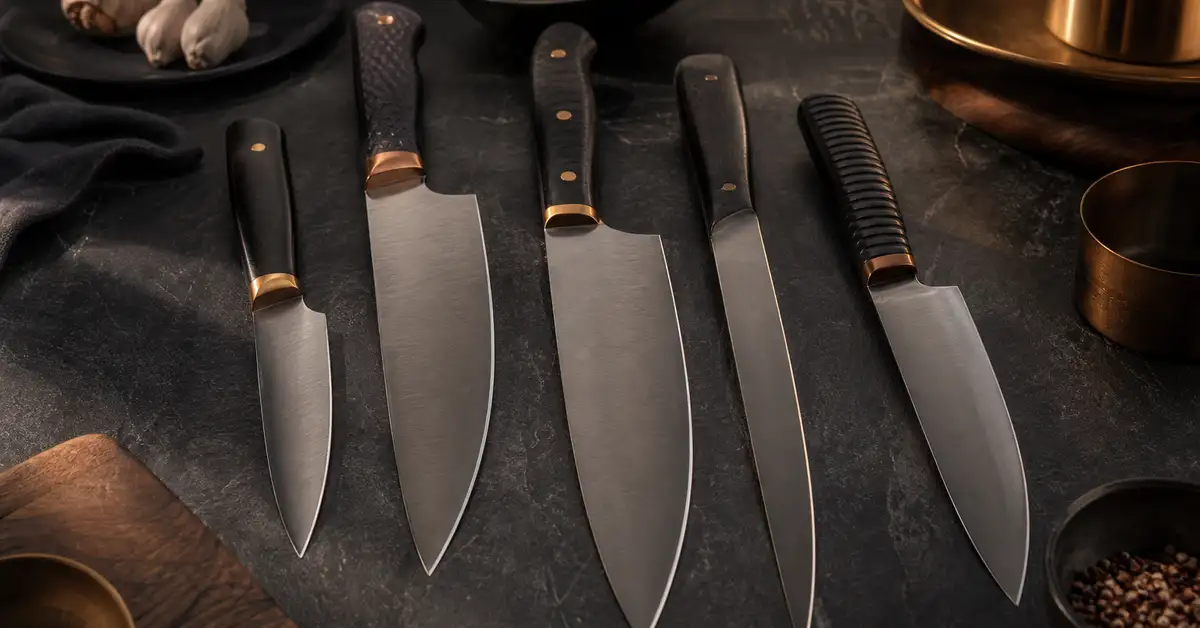
| Knife | Steel / hardness | Handle | Price |
|---|---|---|---|
| Henckels International Classic | Forged high-carbon / n/a | Polypropylene, full bolster | $ |
| Farberware Edgekeeper | Forged high-carbon stainless / n/a (HRC not published) | Ergonomic, w/ sheath | $ |
| Dalstrong Gladiator | High-carbon German / 56+ HRC | ABS or G10 | $$ |
| Wüsthof Pro | X50CrMoV15 / 58 HRC | Polypropylene | $$ |
| Zwilling Four Star | X50CrMoV15 FRIODUR / 57 HRC | Polypropylene | $$$ |
| Wüsthof Classic Ikon | X50CrMoV15 PEtec / 58 HRC | Contoured POM | $$$ |
| Wüsthof Performer | X50CrMoV15 + DLC / 58 HRC | Glass-fiber polyamide | $$$ |
| Miyabi Kaizen II | FC61 Damascus / 61 HRC | Traditional Japanese | $$$$ |
How to choose your 8-inch knife
A few honest questions narrow the field faster than any spec sheet:
- How much do your knuckles clear the board? A taller blade at the heel (the Performer’s 1.87″ or the Four Star’s 1.75″) gives more clearance than a shorter one — worth considering if you find your knuckles brushing the board on a standard blade.
- German-forgiving or Japanese-acute? Most picks here (Henckels International, Farberware, Dalstrong, Wüsthof Pro, Zwilling Four Star) favor a tougher, more forgiving edge that wants frequent honing. Only the Miyabi leans harder and more acute, cutting more cleanly but demanding more careful technique and boards.
- Want built-in edge maintenance? The Farberware Edgekeeper is the only knife here with a self-sharpening sheath — a genuine, testable feature that hones the edge with every draw, rather than a spec you have to take on faith.
- Do you need NSF certification? The Dalstrong Gladiator and Wüsthof Pro are both NSF-listed, built for commercial kitchens but equally at home domestically if you want that certification.
- Wüsthof or Zwilling? Both brands appear on this list, and the differences run deeper than any single 8-inch knife shows — see our full Wüsthof vs Zwilling comparison for company history, steel and construction.
- How much do you value handle comfort specifically? If long prep sessions are your norm, the Classic Ikon’s contoured grip or the Performer’s textured Hexagon Power Grip are worth the premium over a standard straight handle.
Frequently asked questions
Is an 8-inch chef’s knife better than a 6-inch or 10-inch?
Not universally — it depends on your hands and how you cook. An 8-inch blade balances reach and control better than the alternatives for most home cooks: long enough to rock through an onion or halve a squash in one motion, but short enough to stay controllable without much of a learning curve. A 6-inch blade suits smaller hands or smaller boards; a 10-inch blade rewards big-batch cooking but asks more of your technique. For most people, 8 inches is the safer default, which is why it’s the length most manufacturers and reviewers recommend as standard.
Does blade height matter at 8 inches?
Yes, more than most buyers expect. A taller blade at the heel gives your knuckles more clearance over the cutting board during repetitive chopping, which matters more the longer your prep sessions run. It’s worth checking this spec specifically rather than assuming all 8-inch knives are interchangeable.
What’s the difference between these Wüsthof lines?
Wüsthof Pro is a plainer, NSF-listed line built for commercial kitchens with a polypropylene handle. Classic Ikon shares the standard Classic’s PEtec-sharpened steel but adds a more contoured, ergonomic handle. Performer is the newest line, adding a Diamond-Like Carbon coating for extra surface hardness and a distinctive textured grip. All three use similar core steel but differ meaningfully in handle, finish and intended use.
Is a harder steel always better for an 8-inch knife?
Not necessarily. Harder steel (like the Miyabi Kaizen II’s 61 HRC) holds an edge longer and cuts more cleanly, but it’s more brittle and less forgiving of twisting, prying, or a hard cutting surface. Softer, tougher steel (56–58 HRC, like most German-style knives here) is more forgiving of everyday abuse but needs honing more often.
Should I buy an 8-inch knife with NSF certification for home use?
NSF certification isn’t necessary for home cooking, but it’s a genuine mark of commercial-grade construction and food-safety compliance. The Dalstrong Gladiator and Wüsthof Pro both carry it, so home cooks who want that assurance, or who occasionally cook in a shared or commercial-adjacent kitchen, get it as a bonus rather than a requirement.
The verdict
If you want the most forged knife for the least money at this exact length, the Henckels International Classic delivers genuine value. Want the most rigorously tested budget pick? The Farberware Edgekeeper — independently ranked best overall among budget-tier chef’s knives by The Kitchn — is the choice, and its self-sharpening sheath is a genuine bonus. For a comfortable everyday upgrade, the Wüsthof Classic Ikon‘s contoured handle is hard to beat, and enthusiasts ready to invest in the sharpest possible 8-inch edge should look at the Miyabi Kaizen II. Whichever you choose, pair it with the right board and sharpener — see our best cutting boards and our best knife sharpeners to round out the setup.
Sources & method: Specifications independently verified against manufacturer product documentation (Henckels/Zwilling, Farberware, Dalstrong, Wüsthof, Miyabi/Zwilling); cross-checked against specialist knife-review coverage, including The Kitchn’s tested roundup of budget-tier chef’s knives. Screened against the US Consumer Product Safety Commission (CPSC) recall database; no active recalls found for the recommended knives or brands as of 2026. We don’t physically test knives ourselves — here’s how we choose.