Transparency first: This guide contains affiliate links. If we’re enrolled in an affiliate program, we may earn a commission at no extra cost to you — it never affects how we research or rank. Read our full affiliate disclosure policy.
Japanese-style knives cut differently — thinner, harder, more acute — and once you’ve felt one glide through a tomato without crushing it, it’s hard to go back. Below are ten specific gyuto and santoku knives worth your money in 2026, from an honest budget workhorse to a genuine splurge, plus the steel, angle and care basics that explain why Japanese blades behave the way they do. New to knives altogether? Start with our chef’s knife guide for the fundamentals, or see our best chef’s knives if you’d rather stick with a Western-style blade.
How we chose
We’re a research-led site, not a testing lab — we don’t run our own edge-retention rigs, and we won’t claim to have personally used every knife below. We built this list from current 2025–2026 testing at Serious Eats, America’s Test Kitchen and Food & Wine, specialist reviews from Nothing But Knives and KitchenKnifeGuru, and manufacturer specifications for steel, hardness and edge geometry. Every pick below is independently confirmed as currently sold through the manufacturer or a major US retailer, and screened against the US CPSC recall database — no active recalls found for any of these knives or brands as of 2026. Prices move, so we use price bands rather than list a number for each knife — our ladder runs under $25 · $25–75 · $75–150 · $150–300 · $300–700 · $700+ — and we send you to the retailer for today’s figure. Here’s our full method.
Japanese vs Western steel and geometry, briefly
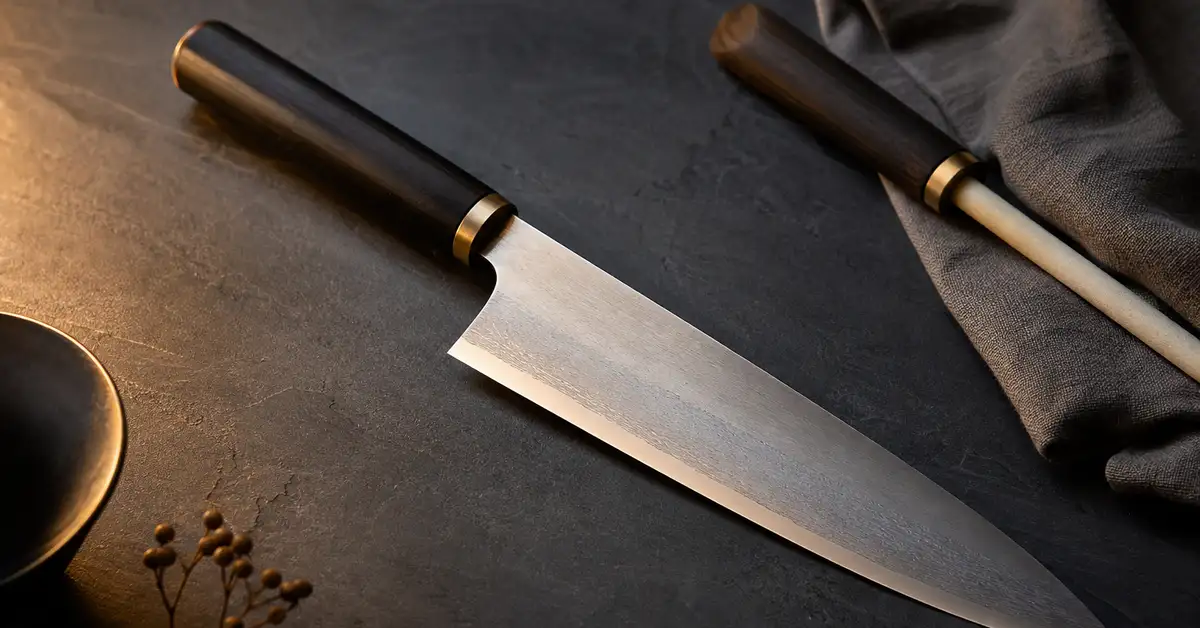
The short version: Japanese-style knives typically run harder — roughly 58–65 HRC versus the 55–58 HRC common on German-style knives — which lets makers grind them thinner and to a more acute angle, often 9–16° per side versus 15–20° on a typical Western blade. That’s why a good Japanese knife feels almost unreasonably sharp out of the box. The trade-off is brittleness: harder steel holds an edge longer but chips more easily on bones, frozen food, or a hard twisting cut. Nearly every knife below is double-bevel (ground on both sides, usable by right- or left-handers), which is what we’d recommend for a home cook — traditional single-bevel knives (yanagiba, deba, usuba) are precise but demand real skill and aren’t a first purchase. A few of the gyuto below use an asymmetrical double bevel (70/30 or similar), which subtly steers the cut for right-handed users; we flag it where it applies.
The best Japanese knives of 2026
1. Tojiro DP VG10 Gyuto (210mm / F-808)
What it is: A genuine Japanese-made gyuto that punches far above its price — the knife specialist retailers point to when someone asks “where do I start with Japanese knives?”
Best for: A first Japanese knife for a cook ready to leave Western steel behind without spending big to find out if they like it.
Specs: 210mm (8.3″) gyuto; three-layer San Mai construction, VG10 core clad in 13-chrome stainless; hardness ~59–60 HRC; double-bevel edge (50/50 grind), 9–12° per side; Western-style laminated wood handle; about 6.6 oz.
- Pros: Genuine VG10 performance at an entry price; easy-care stainless cladding; Western handle feels immediately familiar.
- Cons: Simpler finish than premium lines; still needs the same careful technique as any hard Japanese steel.
Why we trust it: A recurring specialist-retailer recommendation for a first genuine Japanese gyuto, and a Good Design Award winner for its maker, Tojiro.
2. Global G-2 8″ Chef’s Knife
What it is: The recognizable all-steel Japanese gyuto that’s been a Western-kitchen staple for decades — lighter and thinner than a German knife, but noticeably more forgiving than most Japanese blades.
Best for: Cooks who want a Japanese-made knife that tolerates a slightly less careful hand while you build technique.
Specs: 8″ (200mm) blade; Cromova 18 stainless steel (developed for Global); hardness ~56–58 HRC; convex grind, double bevel starting near 12°; hollow-handle all-steel construction with dimpled grip; about 6 oz.
- Pros: Tougher than most Japanese knives at this hardness; good food release from the convex grind; dishwasher-tempting all-steel body (still hand-wash it).
- Cons: The convex grind is genuinely harder to sharpen well at home; the slim steel handle can feel slippery wet.
Why we trust it: A long-running specialist-review favorite precisely because its moderate hardness makes it more forgiving than harder Japanese steel, without giving up the Japanese thinness and feel.
3. Mac Professional MTH-80 8″ Chef’s Knife
What it is: A Western-profile gyuto that’s become a benchmark “best overall” pick in current editorial testing — curved enough to rock-chop, thin and hard enough to cut like a genuine Japanese blade.
Best for: A cook who wants a single do-everything Japanese-style knife without relearning their knife technique.
Specs: 8″ blade; sub-zero-tempered high-carbon molybdenum-vanadium steel; hardness 61 HRC; 15° double bevel per side; triple-riveted Pakkawood handle with steel bolster; about 6.8 oz; made in Japan.
- Pros: Consistently a top pick in current chef’s-knife testing; dimpled blade face reduces sticking on starchy food; forgiving-enough curve for a rocking cut.
- Cons: Still a hard Japanese steel — avoid bones and frozen food; pricier than the Tojiro or Global.
Why we trust it: A recurring “best overall” or premium pick across current chef’s-knife roundups, cited specifically for its balance of sharpness and everyday usability.
4. Mac Hollow Edge Santoku (MSK-65)
What it is: A dedicated vegetable knife — shorter and taller than a gyuto, ground with hollow scallops that keep sticky produce from clinging to the blade face.
Best for: A second knife alongside a gyuto or Western chef’s knife, for cooks who do a lot of vegetable prep — see our best santoku knives for more picks.
Specs: 6.5″ blade; roll-forged chrome-moly-vanadium steel; hardness 61 HRC; 15° double bevel per side; hollow-ground faces; Pakkawood handle with steel bolster; about 6.1 oz.
- Pros: Repeatedly named the top santoku performer in current testing; genuinely excellent at slicing tomatoes and herbs cleanly; light, balanced feel.
- Cons: A specialist second knife, not a do-everything blade; same care needs as any hard Japanese steel.
Why we trust it: Current santoku testing singles this knife out repeatedly for cutting cleanly through rubbery tomatoes and tender herbs where other santokus struggled.
5. Shun Classic 8″ Chef’s Knife (DM0706)
What it is: The knife most Americans picture when they think “Japanese chef’s knife” — a VG-MAX core wrapped in visible Damascus cladding, in a shape that feels immediately familiar.
Best for: Cooks upgrading from a Western knife who want Japanese performance and a knife that looks the part.
Specs: 8″ blade; VG-MAX steel core clad in 34 layers of Damascus stainless per side; hardness 61 HRC; 16° double bevel per side; Pakkawood handle with steel bolster and end cap; about 1 lb with full tang.
- Pros: Genuinely sharp out of the box and holds it well; widely available with strong parts/warranty support; striking Damascus finish.
- Cons: Brittle at the edge like any 61 HRC steel — no bones, no twisting cuts; a real step up in price from the Tojiro or Global.
Why we trust it: One of the most consistently recommended Japanese knife lines across current editorial testing, prized for the balance of Western ergonomics with genuine Japanese-level sharpness.
6. Shun Premier 8″ Chef’s Knife (TDM0706)
What it is: Shun’s Western-shaped chef’s knife that specialist reviewers describe as cutting like a genuine Japanese blade — the same VG-MAX core as the Classic, in a hammered tsuchime finish that helps food release.
Best for: A cook who wants a familiar Western blade shape but isn’t willing to give up Japanese-level sharpness to get it.
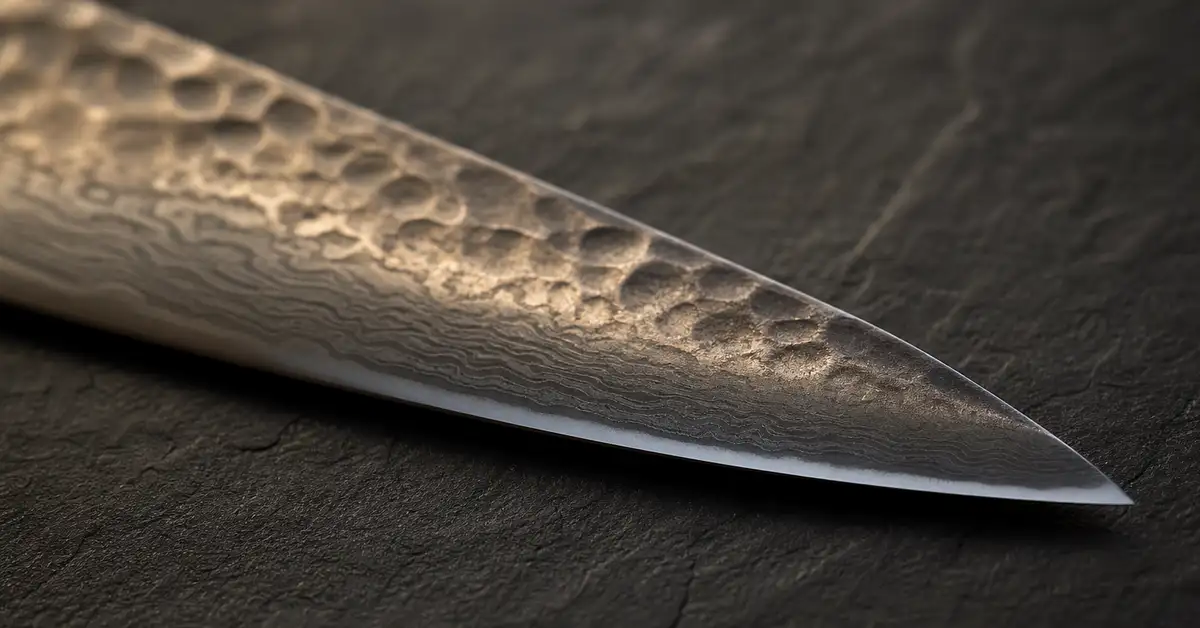
Specs: 8″ blade; VG-MAX core clad in 69 layers of Damascus; hardness 61 HRC; 16° double bevel per side, flat grind; hammered tsuchime spine finish; walnut-toned Pakkawood handle; about 7.3 oz.
- Pros: Specialist reviewers rank its out-of-the-box sharpness among the best they’ve tested; Western profile suits cooks who rock-chop.
- Cons: Same brittleness as any 61 HRC blade, arguably more tempting to abuse given its familiar Western shape; some testers note more food sticking on the hammered face than expected.
Why we trust it: A specialist in-depth review called its factory edge some of the sharpest they’d seen, while explicitly warning it needs Japanese-knife care despite its Western looks.
7. Yoshihiro VG10 46-Layer Hammered Damascus Gyuto (8.25″)
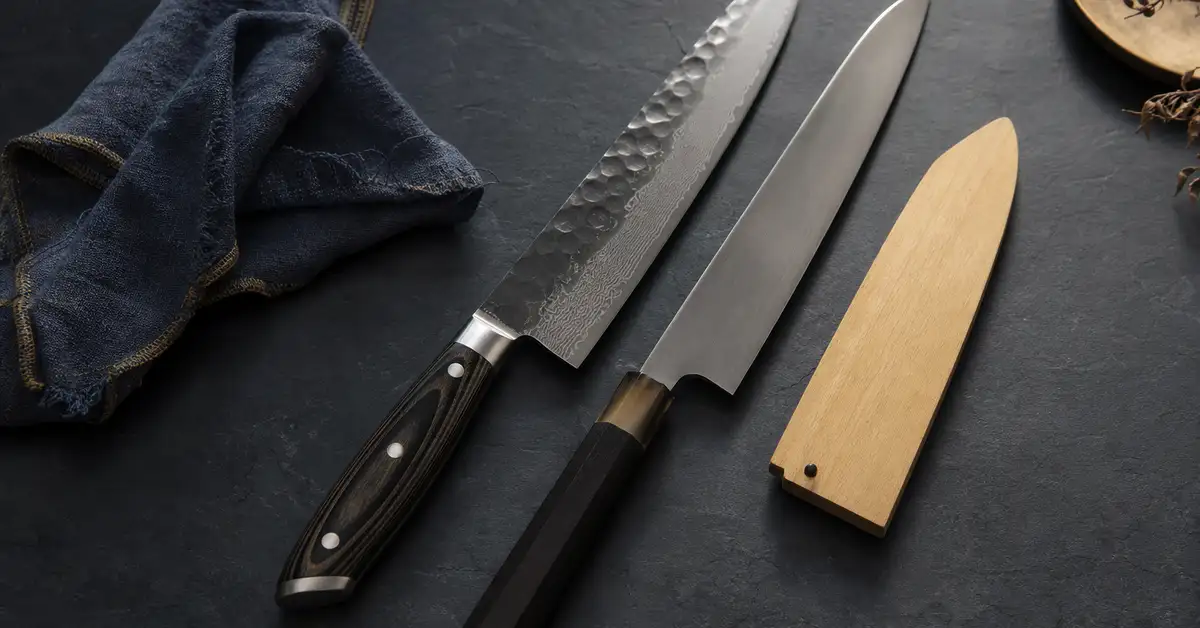
What it is: A hand-forged, hammered Damascus gyuto from a specialist Japanese cutlery house, sold with a wooden saya sheath included — built for cooks who want craft and looks alongside performance.
Best for: A cook assembling a curated set of Japanese knives who wants genuine forged construction, not just a factory blade.
Specs: 8.25″ (210mm) gyuto; VG10 core hand-forged and hammered with 46 layers of Damascus cladding; hardness ~60 HRC; double bevel; octagonal wood handle (multiple wood options); includes a wooden saya.
- Pros: Genuine hand-forged construction with real craft behind it; hammered texture reduces food sticking; thin, light blade that’s easy to maneuver; ships with its own sheath.
- Cons: Octagonal wa-handle feels different from a Western grip at first; standard 60 HRC care rules apply.
Why we trust it: A long-running specialist-retailer bestseller specifically for combining genuine forged Damascus construction with accessible VG10 performance.
8. Miyabi Mizu SG2 8″ Gyuto
What it is: A premium gyuto built around SG2 powder steel — a modern, ultra-fine-grained steel that lets makers grind an unusually thin, stable edge without immediate chipping.
Best for: An enthusiast home cook who already has good technique and wants the sharpest, longest-holding edge they can reasonably maintain themselves.
Specs: 8″ blade (13.25″ overall); SG2 powder steel core, three-layer stainless-clad construction; hardness 63 HRC; double bevel, hand-honed 9–12° per side; D-shaped black micarta handle; about 7.5 oz. Handcrafted in Seki, Japan.
- Pros: Exceptional edge retention thanks to powder steel; specialist reviewers describe the resulting edge as “very thin and very stable” when sharpened well.
- Cons: The hardest, most demanding steel on this list — sharpening it well takes real skill; a genuine splurge.
Why we trust it: Specialist reviewers single out its powder-steel performance as a step above typical VG10 or VG-MAX knives, while being upfront that it demands a more careful, experienced owner.
9. Masamoto VG Gyuto (180mm / 7″)
What it is: A shorter gyuto from one of Japan’s most storied knife houses — genuinely sharp and thin, but a size down from the usual 8-inch default, and noticeably more forgiving steel than most Japanese blades.
Best for: A smaller kitchen, a smaller cutting board, or a cook who prefers a lighter, shorter blade day to day.
Specs: 180mm (7″) blade; Hyper Molybdenum-Vanadium stain-resistant steel; hardness ~58–59 HRC; asymmetrical 70/30 double-bevel edge; Duracon resin handle with steel bolster, full tang.
- Pros: More forgiving hardness than most Japanese steel while staying genuinely sharp; compact size suits smaller hands and boards; heritage maker with a long reputation.
- Cons: The 70/30 bevel is right-hand-biased, which can feel slightly off for left-handed cooks; sold without a sheath, so budget for one.
Why we trust it: Masamoto is one of the most established names in Japanese professional cutlery, and this line is consistently recommended as a more forgiving entry point into their steel.
10. Misono UX10 Gyuto (240mm)
What it is: A professional-grade gyuto built from high-purity Swedish stainless steel, longer than most home-kitchen knives and aimed at cooks who already have serious sharpening habits.
Best for: An experienced home cook or serious enthusiast who owns a quality sharpener and wants a knife that rewards it.
Specs: 240mm (9.4″) blade; high-purity Swedish stainless steel; hardness ~59–60 HRC; asymmetrical 70/30 double bevel; composite wood handle; about 8.5 oz.
- Pros: Exceptionally refined, low-impurity steel that takes a very clean edge; longer blade suits big-batch prep and larger produce.
- Cons: The most expensive knife here by a wide margin; a 240mm blade is more knife than most home kitchens need; the 70/30 bevel favors right-handers.
Why we trust it: Current editorial testing specifically recommends this knife to cooks who already own a good sharpener, citing its steel quality as the reason it rewards that investment.
Japanese knives compared
| Knife | Shape | Hardness | Edge angle | Price |
|---|---|---|---|---|
| Tojiro DP VG10 210mm | Gyuto | ~59–60 HRC | 9–12° (50/50) | $75–150 |
| Global G-2 | Gyuto | ~56–58 HRC | ~12° convex | $75–150 |
| Mac MTH-80 | Gyuto (Western profile) | 61 HRC | 15° | $150–300 |
| Mac Hollow Edge Santoku | Santoku | 61 HRC | 15° | $75–150 |
| Shun Classic 8″ | Gyuto (Western profile) | 61 HRC | 16° | $150–300 |
| Shun Premier 8″ | Gyuto (Western profile) | 61 HRC | 16° | $150–300 |
| Yoshihiro VG10 Damascus | Gyuto | ~60 HRC | Double bevel | $75–150 |
| Miyabi Mizu SG2 | Gyuto | 63 HRC | 9–12° | $150–300 |
| Masamoto VG 180mm | Gyuto (compact) | ~58–59 HRC | 70/30 asymmetric | $150–300 |
| Misono UX10 240mm | Gyuto (large) | ~59–60 HRC | 70/30 asymmetric | $150–300 |
How to choose a Japanese knife
A few honest questions narrow the field faster than any spec sheet:
- Gyuto or santoku? A gyuto is the Japanese equivalent of a Western chef’s knife — the do-everything default. A santoku is shorter, flatter, and built for push-cutting vegetables; it’s a great second knife, not usually a first one.
- Western handle or wa-handle? Western-style handles (Pakkawood, resin, steel) feel immediately familiar to most US cooks. Traditional octagonal wa-handles are lighter and more balance-forward but take a little getting used to.
- How much steel hardness do you actually want? Higher HRC holds an edge longer but chips more easily; the Global G-2 and Masamoto VG trade a little edge retention for real forgiveness, while the Miyabi SG2 and Misono UX10 ask for real skill and care in return for their performance.
- Double-bevel, always, for a first knife. Every knife on this list is double-bevel, which is the right call for a home kitchen. Single-bevel knives (yanagiba, deba, usuba) are precision tools for specialists, not general-purpose blades.
Frequently asked questions
What’s the difference between a gyuto and a santoku?
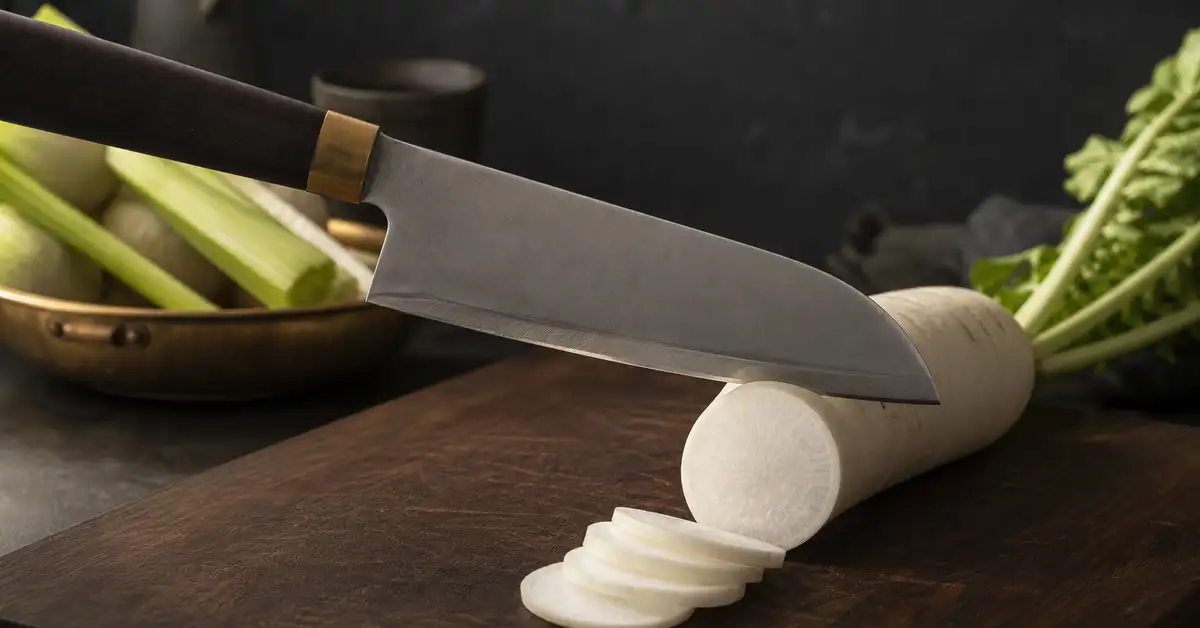
A gyuto is the Japanese version of a Western chef’s knife — longer, with some curve to the edge for rocking, and built as a do-everything blade. A santoku is shorter and taller with a flatter edge, optimized for push-cutting vegetables, herbs and boneless proteins. Most cooks are best served starting with a gyuto and adding a santoku later if they do a lot of vegetable prep.
Are Japanese knives worth the extra care?
For most cooks, yes. The trade is real: harder, thinner steel cuts noticeably better and holds its edge longer, but it needs hand-washing, careful storage and more thoughtful sharpening than a forgiving German knife. If you’re not ready to commit to that care, a good Western knife is still an excellent choice — see our best chef’s knives.
Should I buy a single-bevel or double-bevel Japanese knife?
Double-bevel, for a first knife and almost certainly for a second and third. Single-bevel knives (yanagiba, deba, usuba) are traditional specialist tools that demand advanced sharpening skills and are usually strongly handed. Every knife recommended above is double-bevel for exactly this reason.
Why do Japanese knives chip more easily than German knives?
It comes down to hardness. Japanese steel is typically tempered to 58–65 HRC versus roughly 55–58 HRC for German steel, which lets it hold a thinner, sharper edge for longer — but harder steel flexes less and is more prone to chipping on bones, frozen food, or a twisting cut. Treat a Japanese knife as a precision tool rather than an all-purpose workhorse and it will reward you for years.
What angle should I sharpen a Japanese knife at?
Match the knife’s own factory angle where you can find it — most on this list run 9–16° per side, noticeably more acute than a typical Western knife’s 15–20°. A guided sharpening system with a low-angle setting takes the guesswork out; see our best knife sharpeners for options suited to harder steel.
Can I put a Japanese knife in the dishwasher?
No. Heat, detergent and knocking around in a dishwasher will dull the edge and can damage handles, especially wood ones. Hand-wash and dry every Japanese knife immediately after use, the same rule that applies to any quality knife.
The verdict
If you want to try a genuine Japanese gyuto without much risk, start with the Tojiro DP VG10 or the Global G-2. For a single do-everything Japanese-style knife, the Mac MTH-80 or Shun Classic are the safest, most-tested picks. Cooks who do serious vegetable prep should add the Mac Hollow Edge Santoku alongside a gyuto. And if you already have the technique and sharpening habits to match, the Miyabi Mizu SG2 or Misono UX10 deliver a genuinely different level of edge. Whatever you choose, pair it with the right sharpener and a light touch — see our chef’s knife guide for the fundamentals that apply to every blade in your kitchen.
Sources & method: Performance and ranking claims drawn from Serious Eats, America’s Test Kitchen and Food & Wine’s 2025–2026 testing, and specialist reviews at Nothing But Knives and KitchenKnifeGuru; specifications independently verified against manufacturer and specialist-retailer product pages (Mac Knife, Shun/Kai, Global Cutlery, Miyabi/Zwilling, Tojiro, Yoshihiro/eChefKnife, Masamoto/Korin, Misono). Screened against the US Consumer Product Safety Commission (CPSC) recall database; no active recalls found for the recommended knives or brands as of 2026. We don’t physically test knives ourselves — here’s how we choose.