Ask ten cooks whether a Japanese or a German knife is “better” and you’ll get ten confident, contradictory answers. The honest truth is neither wins outright — they’re built around different trade-offs, and the right one depends on how you actually cook, not on which looks more impressive in a knife roll. This guide lays out exactly where the two styles differ — steel, hardness, edge angle, weight, care — so you can decide with real information instead of marketing language. If you haven’t read the fundamentals yet, start with our chef’s knife guide; if you already know you want Japanese steel, go straight to our best Japanese knives, or see our best chef’s knives for the German-style shortlist.
The short answer
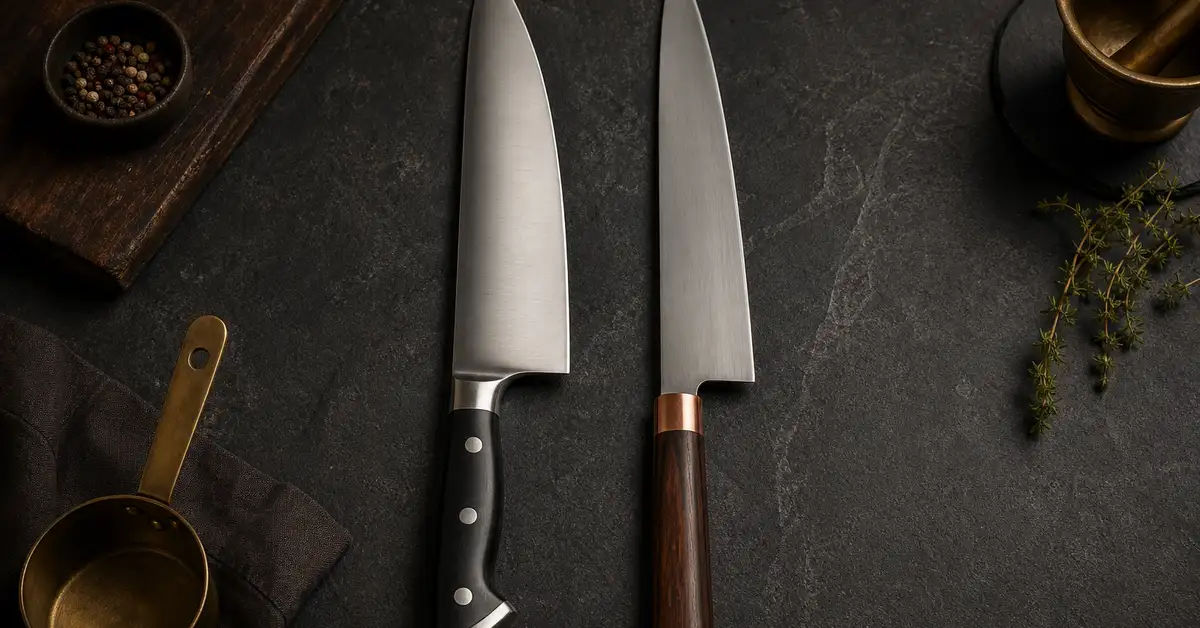
German-style knives (Wüsthof, Zwilling, Henckels) are built for durability and forgiveness: tougher stainless steel, a thicker edge, and a heavier, curved blade that’s hard to damage and easy to sharpen. Japanese-style knives (Shun, Mac, Global, Tojiro, Miyabi) are built for cutting performance: harder steel ground thinner and more acutely, which slices more cleanly and holds an edge longer, but chips more easily and demands more careful handling. Neither is a mistake — they’re different answers to “what should a knife trade off?” We’re a research-led site and don’t run our own edge-retention rigs; the figures below come from published manufacturer specifications and current independent testing, cross-checked against our own knife guides. Here’s our full method.
Steel and hardness
The single biggest difference is the steel itself, measured in HRC (Rockwell hardness). German knives typically use tough, high-carbon stainless steel — the classic alloy is X50CrMoV15 — tempered to roughly 55–58 HRC. Japanese knives run harder: common steels like VG-10, VG-MAX and AUS-10 sit around 58–61 HRC, and premium “powder” steels like SG2 can reach 63–65 HRC. As a rule of thumb, higher hardness holds a sharper edge for longer but is more brittle and prone to chipping; lower hardness is more forgiving of abuse but dulls sooner and needs more frequent honing. Neither figure tells you which knife is “better” — it tells you which knife suits how carefully you handle a blade.
Edge geometry and cutting style
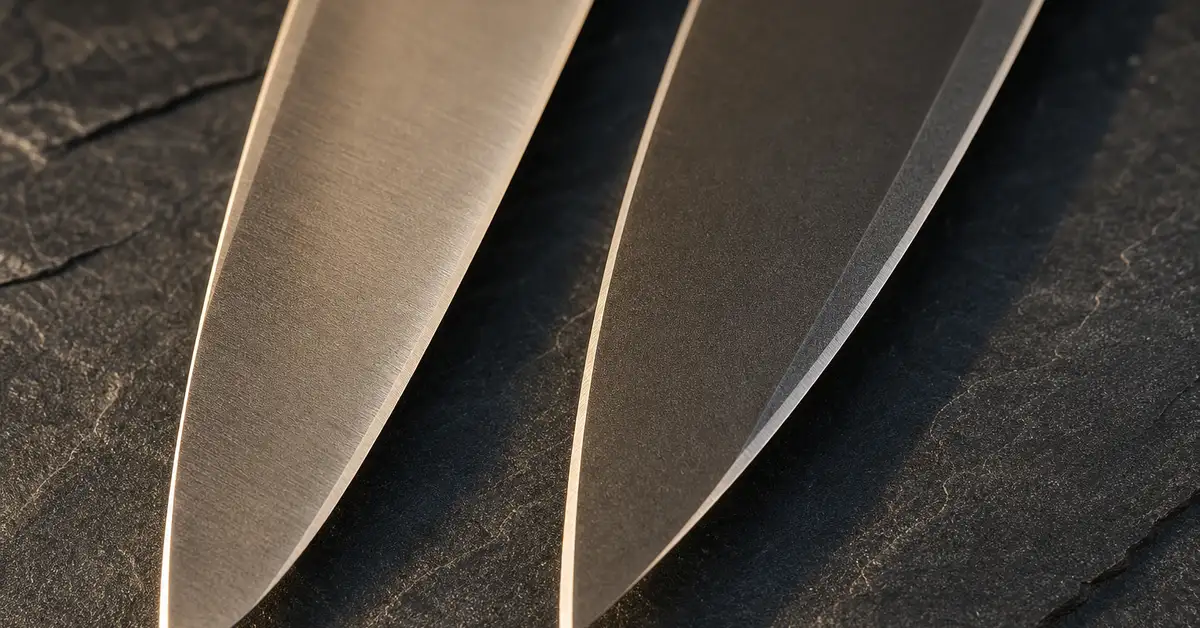
Hardness is only half the story — the other half is how the edge is ground. German knives are typically ground to around 14–20° per side (Wüsthof’s modern PEtec edge is about 14°; older German blades sit closer to 20°), with a pronounced curved belly that’s built for a rock-chop — keeping the tip on the board and rocking through herbs and vegetables. Japanese knives run more acute, typically 9–16° per side, with a flatter profile suited to a push or pull cut — lifting the blade fully off the board between strokes. A thinner, more acute edge slices with less resistance and crushes less delicate produce, but it’s also the reason Japanese blades are less tolerant of twisting, prying, or a hard landing on bone.
| German-style | Japanese-style | |
|---|---|---|
| Typical brands | Wüsthof, Zwilling, Henckels, Mercer | Shun, Mac, Global, Tojiro, Miyabi, Masamoto, Misono |
| Typical steel | High-carbon stainless (e.g. X50CrMoV15) | VG-10, VG-MAX, AUS-10, powder steels (SG2) |
| Hardness | ~55–58 HRC | ~58–65 HRC |
| Edge angle (per side) | ~14–20° | ~9–16° |
| Blade profile | Curved belly — rock-chop | Flatter — push/pull cut |
| Weight & feel | Heavier, does some of the work for you | Lighter, faster, more precise |
| Edge retention | Shorter — hone often | Longer, but chips more easily |
| Maintenance | Forgiving, easy to sharpen at home | Needs careful handling, low-angle sharpening |
| Typical price | $–$$$ | $–$$$$ |
Weight, balance and everyday feel
German knives tend to be heavier and bolder, with a bolster and a full tang that put weight behind the blade — that mass does some of the cutting work for you, which many cooks find reassuring on tough vegetables or protein. Japanese knives are typically lighter and thinner, favoring control and precision over momentum; they reward a lighter touch and a more deliberate cutting motion. Neither is objectively more comfortable — hand size, grip style and how you actually move the knife all matter more than any spec sheet. If you can, hold both before you decide; see the pinch-grip test in our chef’s knife guide.
Maintenance and care
This is where the trade-off gets real day to day. A German knife tolerates more: it hones easily on a steel, sharpens well on almost any system, and shrugs off the occasional twist or awkward cut. A Japanese knife asks for a gentler hand — hand-wash and dry immediately, avoid bones and frozen food, and sharpen on a whetstone or a guided system built for low angles rather than an aggressive pull-through designed for softer steel. Neither knife should ever see a dishwasher. If you’re not sure how much maintenance you’ll realistically keep up with, that answer alone often settles the debate — see our best knife sharpeners and honing vs sharpening for the specifics of keeping either style in good shape.
Which should you buy?
A few honest questions narrow it down faster than any spec sheet:
- How careful are you with a knife, honestly? If you cut on the wrong surface, twist through a squash, or leave a knife in the sink, a forgiving German blade will serve you far better than a brittle Japanese edge.
- Do you want the sharpest possible edge, or the most durable one? Japanese steel wins on raw sharpness and edge retention; German steel wins on toughness and ease of upkeep.
- How much do you already know about sharpening? German knives are more forgiving to sharpen at home. Japanese knives reward — and arguably require — a whetstone or a guided low-angle system.
- What’s your budget and how many knives do you want? A great German knife can be had inexpensively (see the Victorinox Fibrox in our best chef’s knives); a great entry Japanese gyuto costs a bit more but isn’t out of reach (see the Tojiro DP in our best Japanese knives).
And you don’t have to choose only one. Plenty of well-equipped kitchens run a German knife as the daily workhorse and a Japanese knife for finer work — or a “hybrid” knife that pairs a Western handle with harder Japanese-style steel, splitting the difference. There’s no wrong answer here, only the one that matches how you actually cook.
Ready to choose a specific knife?
See our full, independently verified shortlists for each style:
Frequently asked questions
Is a Japanese knife sharper than a German knife?
Out of the box, generally yes. Japanese steel is typically harder and ground to a more acute angle, which produces a keener edge that stays sharp longer. A well-maintained German knife can still feel very sharp, but it won’t match a Japanese edge’s ultimate keenness or edge retention.
Are Japanese knives more fragile than German knives?
Yes, relatively. The same hardness that gives Japanese steel its sharp, long-lasting edge also makes it more brittle — more prone to chipping on bones, frozen food, or a twisting motion. German steel is softer and more forgiving of that kind of abuse, at the cost of dulling sooner.
Which is easier to sharpen, German or Japanese steel?
German steel is easier to sharpen at home — it’s softer and more tolerant of an imperfect angle on a pull-through or basic whetstone. Japanese steel’s harder, more acute edge rewards (and largely requires) a whetstone or a guided low-angle sharpening system to get right.
Can I use the same cutting board for both knife styles?
Yes, as long as it’s a knife-friendly surface — wood, rubber or a soft composite, never glass, stone or marble. Japanese knives benefit even more from a gentle board like hinoki or synthetic rubber, since their harder, thinner edge has less margin for a hard surface. See our best cutting boards for specifics.
Should a beginner start with a German or a Japanese knife?
Most beginners are better served starting with a forgiving German-style knife (or a stamped budget knife like the Victorinox Fibrox) while they build basic technique and care habits. A Japanese knife is a great second knife once you’re comfortable with hand-washing, careful storage and gentler cutting habits.
What is a “hybrid” chef’s knife?
A hybrid pairs a Western-style handle and blade profile with harder, Japanese-style steel — giving a familiar grip and rocking motion with a sharper, longer-lasting edge than typical German steel. It’s a popular middle ground for cooks who want some of both worlds.
The bottom line
German and Japanese knives aren’t competing for the same job — they’re built around different priorities. Choose German if you want a forgiving, do-everything knife that shrugs off imperfect technique and sharpens easily. Choose Japanese if raw sharpness and edge retention matter most to you, and you’re willing to treat the knife with more care. Both, used well, will serve you for decades — the “wrong” choice is really just a knife that doesn’t match how you cook. For specific models, see our best chef’s knives and our best Japanese knives, or start from the fundamentals in our chef’s knife guide.
Sources & method: Steel composition and hardness figures from published manufacturer and alloy data (X50CrMoV15, VG-10, VG-MAX, AUS-10, SG2); edge-angle figures from Wüsthof’s PEtec specification and manufacturer/specialist data for the Japanese knives referenced in our best Japanese knives guide; performance context from Serious Eats, America’s Test Kitchen and specialist reviews at Nothing But Knives and KitchenKnifeGuru. We’re a research-led site and don’t physically test knives ourselves — here’s how we choose.